
Domain Authority (DA) is one of the most-cited numbers in SEO. It appears in agency reports, pitch decks, and link-building proposals every day. Yet the people who created it will tell you it does not predict rankings. So why does it keep coming up, and should you care?
The answer is nuanced. DA is useful as a relative benchmark, not an absolute predictor. Understanding what it measures, how it compares to rival metrics, and where it falls short will help you use it correctly rather than chase a number for its own sake.
Definition
Domain Authority (DA) is a proprietary 1-to-100 logarithmic score developed by Moz that predicts how likely a website is to rank in search engine results. It is calculated from linking root domains and other link-related signals. It is not a Google ranking factor.
What Is Domain Authority?
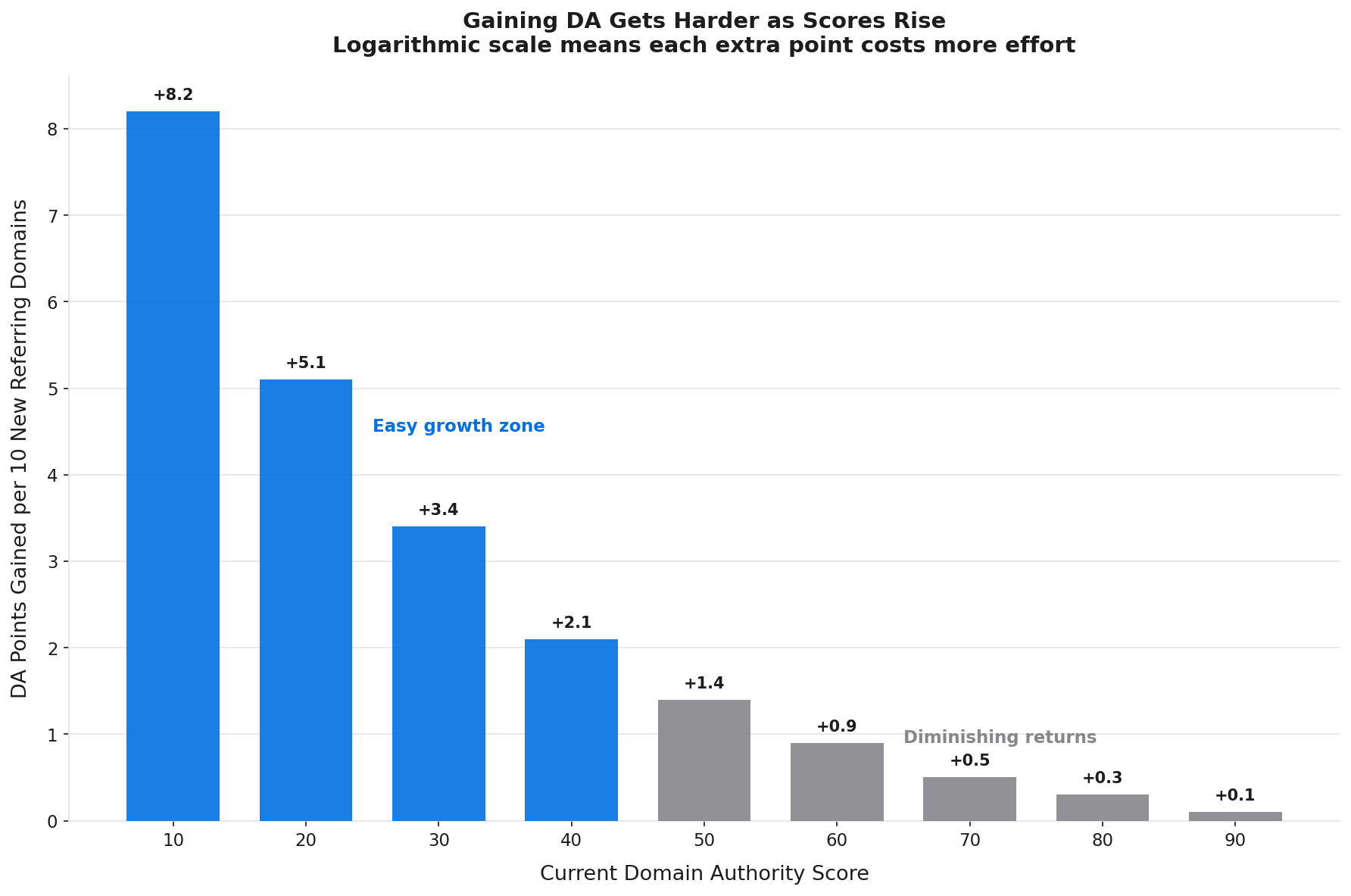
Moz introduced Domain Authority as a way to compare the relative strength of websites using a standardised scale. The score runs from 1 to 100, where higher is better. Because the scale is logarithmic, moving from 20 to 30 is far easier than moving from 70 to 80.
The score is recalibrated regularly. When Moz updates its link index or model, scores across all sites shift simultaneously. That means a drop in your DA does not necessarily mean your site has weakened. It may mean competitors gained ground or the index was refreshed.
Key things DA is not: it is not a Google metric, not part of any ranking algorithm, and not a measure of traffic. Moz is explicit about this.[1]
DA 68
Average Domain Authority of pages ranking in position 1
Source: Linkscope, Domain Authority Ranking Benchmarks
How Is Domain Authority Calculated?
Moz calculates DA using a machine-learning model trained on thousands of search results. The primary inputs are:
- Linking root domains: the number of unique domains linking to a site
- Total number of links: both internal and external link counts
- MozRank and MozTrust: older link-quality signals still factored into the composite score
- Spam Score: a penalty-risk indicator that weighs down low-quality link profiles
The model predicts the probability of a domain appearing in search results relative to all other sites in the Moz index. That is why scores are always relative. A new entrant domain starts at 1 and climbs as it acquires links from other domains. Gaining a single link from a high-DA domain can move a low-DA site noticeably; gaining the same link barely moves a DA 70 site.[1]
One practical implication: you should always compare your DA to direct competitors, not to global benchmarks. A DA of 35 may be excellent in a niche industry and irrelevant in a highly competitive vertical.
DA vs Domain Rating vs Authority Score
Moz is not the only tool that tries to score domain authority. Ahrefs uses Domain Rating (DR), and Semrush uses Authority Score (AS). They measure similar things but use different data sources and methodologies. They do not correlate exactly.
| Metric | Tool | Primary Input | Scale | Google Factor? |
|---|---|---|---|---|
| Domain Authority (DA) | Moz | Linking root domains, spam score | 1-100 (log) | No |
| Domain Rating (DR) | Ahrefs | Referring domains, link strength | 0-100 (log) | No |
| Authority Score (AS) | Semrush | Backlinks, organic traffic, spam | 1-100 | No |
Ahrefs has been notably critical of DA, arguing that Domain Rating correlates more strongly with rankings because it focuses purely on the quality and quantity of referring domains rather than a composite index.[2] A study of 218,713 domains found DR correlated meaningfully with ranking positions. That said, all three metrics share the same core limitation: they are third-party proxies, not official signals.
"DA is best used as a rough competitive benchmarking tool, not as a KPI to optimise directly. The underlying link signals it approximates are what actually matter to search engines."
Rand Fishkin, Moz Founder
Does Domain Authority Still Matter in 2026?
The honest answer: it depends on how you use it.
Research by Onely found a DA-to-rankings correlation of just 0.16, which is weak by any statistical standard.[3] That alone should discourage treating DA as a direct ranking lever. However, correlation with rankings is not the only use case. DA remains valuable for:
- Prospecting: filtering link prospects quickly by rough domain quality
- Competitor benchmarking: comparing your profile against direct rivals in the same niche
- Reporting: giving clients a simple number that tracks link-building progress over time
- Red-flag detection: very low DA (under 10) on new prospects can indicate low-quality or spammy domains
0.16
Correlation coefficient between DA and Google rankings
Source: Onely, DA and DR Correlate with Rankings Study
In 2026, with Google's continued emphasis on helpful content and E-E-A-T signals, relying on DA as a primary strategy metric is a mistake. What matters is building genuine topical authority through quality content, earning links from relevant sources, and structuring your site so Google can understand the relationships between pages. DA may rise as a side effect, but it should not be the goal.
What Is a Good Domain Authority Score?
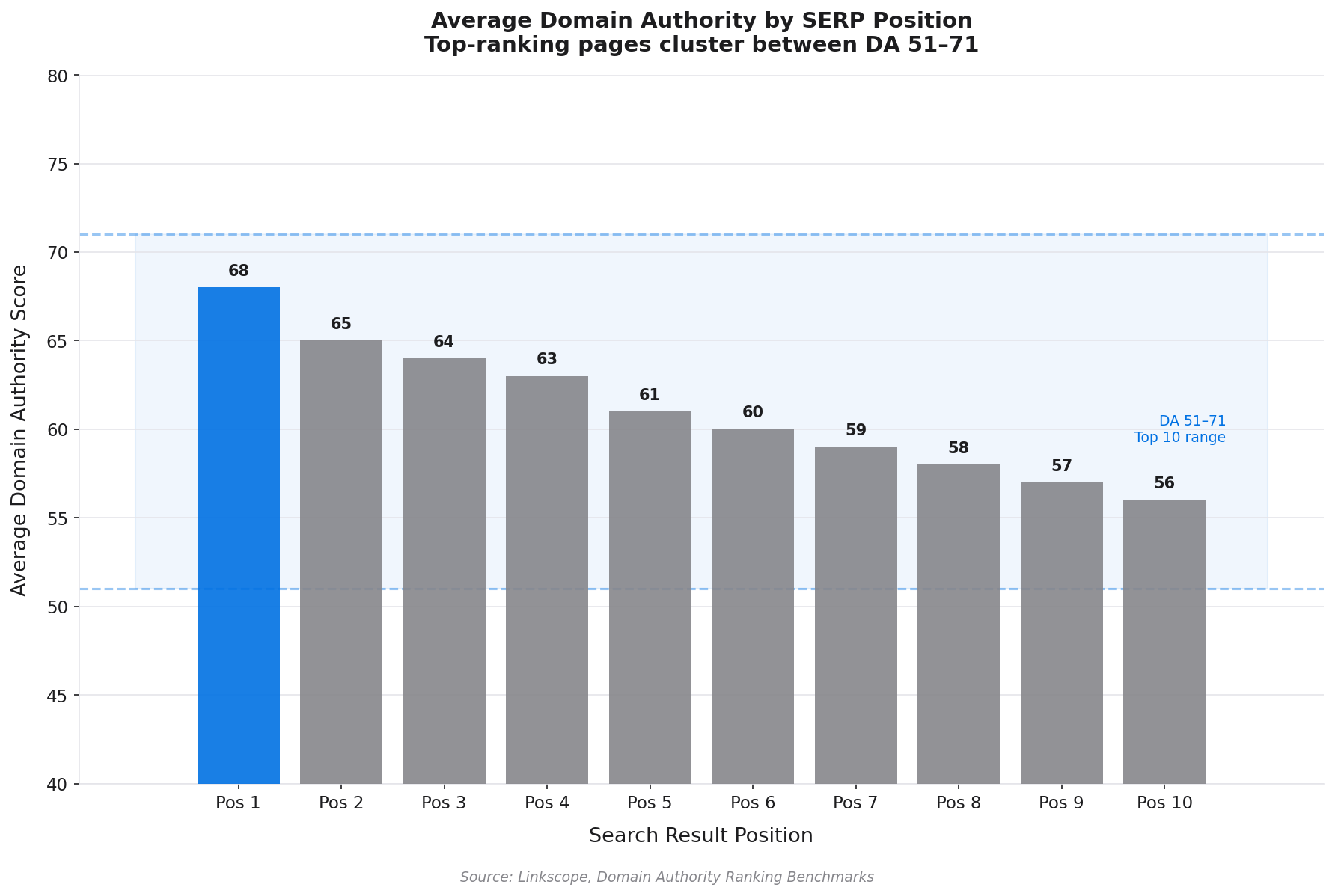
There is no universal "good" DA. Context is everything. According to Linkscope's ranking benchmarks, pages in position 1 have an average DA of 68, while the top 10 spans 51 to 71.[4] But those numbers reflect all industries combined, which makes them misleading for any single niche.
A more useful question is: what DA do your top-ranking competitors have? If they cluster around DA 35, then a DA of 30 is competitive. If they are all at DA 60+, you need a different approach, probably starting with content depth and topical coverage rather than pure link acquisition.
| DA Range | Typical Profile | Competitive Outlook |
|---|---|---|
| 1-20 | New site, few backlinks | Can rank for low-competition keywords |
| 21-40 | Established niche site | Competitive in most niche markets |
| 41-60 | Mid-tier authority site | Competitive in most industries |
| 61-80 | High-authority publisher or brand | Strong competitive position |
| 81-100 | Major brands (Wikipedia, BBC, etc.) | Dominant in nearly all categories |
Linkscope also found that DA 60+ sites are 2.1x more likely to appear in the top 10 results, which confirms that a higher score correlates with better outcomes even if it does not cause them.[4]
How Internal Linking Complements Domain Authority
Most DA-focused advice concentrates entirely on acquiring external backlinks. That is only half the picture. Even a site with a strong DA can underperform if its internal linking structure is poor, because authority acquired through external links needs to be distributed effectively across the site.
Think of it this way: external links bring authority into the domain. Internal links route that authority to the specific pages you want to rank. A page with strong external backlinks pointing to the homepage, but no internal links pointing to a target service page, leaves that page largely isolated from the authority the site has earned.
Common internal linking problems that dilute DA impact include:
- Orphan pages with no internal links pointing to them
- Shallow internal link depth (important pages buried three or more clicks from the homepage)
- Over-linking from low-value pages, diluting anchor signals
- Missing links between topically related content in the same cluster
Tools like Linki audit these patterns automatically, identifying which pages are receiving the most internal PageRank and which are being under-served. This is especially valuable when you are actively building external links: you want to ensure every link you earn flows to pages that need it. See our site architecture guide for how structure and internal linking work together.
5 Ways to Improve Your Domain Authority
DA improvement is a by-product of doing the right things for your site overall. There are no shortcuts that survive algorithm updates.
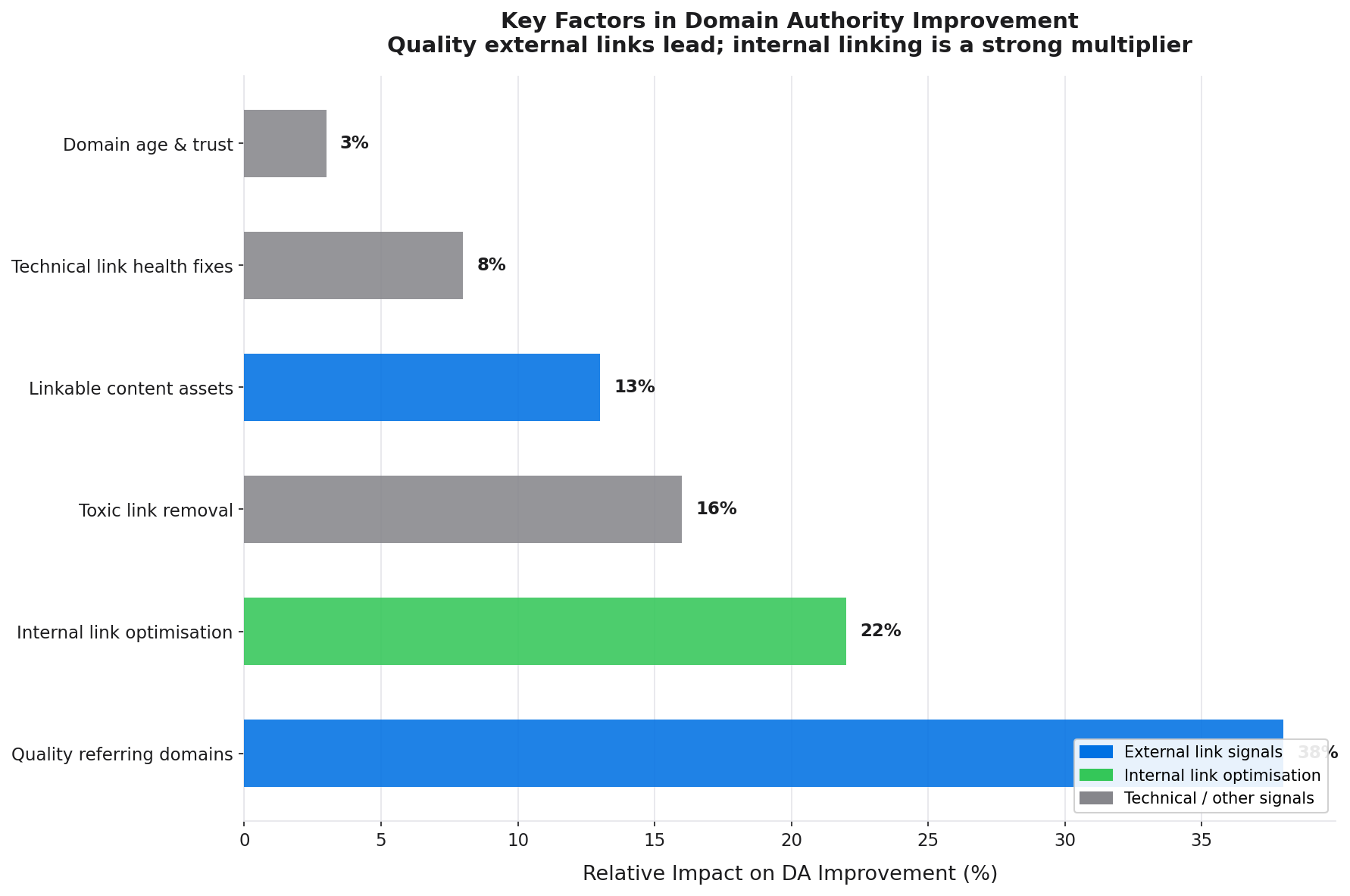
- Earn links from relevant, authoritative domains. Quality outweighs quantity. One link from a DA 70 industry publication does more than fifty links from DA 20 directories. The average page ranking first has 120 unique referring domains.[5]
- Fix your technical link health. Broken links, redirect chains, and canonicalisation issues all bleed link equity. Conduct quarterly audits to address these.
- Remove or disavow toxic links. Low-quality or spammy inbound links inflate your Spam Score and can suppress DA. Use Moz's Link Explorer or Google Search Console to identify and disavow them.
- Build linkable content assets. Original research, data studies, calculators, and definitive guides naturally attract links. See our data-driven content guide for how to create content that earns links without outreach.
- Optimise internal linking with Linki. Route authority from your strongest pages to your target pages. A well-structured internal link network ensures every external link you earn contributes to your ranking goals, not just your homepage's DA.
2.1x
More likely to appear in top 10 results for DA 60+ sites
Source: Linkscope, Domain Authority Ranking Benchmarks
Frequently Asked Questions
What is Domain Authority?
Domain Authority (DA) is a score from 1 to 100 created by Moz that estimates how likely a website is to rank in search engine results pages. It is based primarily on the quantity and quality of external links pointing to a domain. It is not a Google metric and does not directly influence rankings.
How is Domain Authority calculated?
Moz calculates DA using a machine-learning model that considers linking root domains, total backlinks, MozRank, MozTrust, and Spam Score. The model compares a domain against all sites in the Moz index and produces a logarithmic score from 1 to 100. Because it is logarithmic, higher scores become progressively harder to improve.
What is a good Domain Authority score?
A good DA score is relative to your competitors. Pages ranking first on Google average a DA of 68, but this varies widely by industry. For most niche markets, a DA between 30 and 50 is competitive. Always benchmark against the domains you are trying to outrank rather than generic averages.
Does Domain Authority still matter in 2026?
DA retains value as a comparative benchmark and prospecting filter, but it is not a reliable predictor of ranking success. Research from Onely found a correlation of just 0.16 between DA and actual Google positions. In 2026, content quality, topical authority, and internal linking structure are more actionable levers than chasing a higher DA number.
Can internal linking improve Domain Authority?
Internal linking does not directly raise DA, which is based on external links. However, a strong internal link structure ensures that authority acquired through external links is distributed effectively to the pages you want to rank. This maximises the practical value of every external link you earn, which over time contributes to better rankings and, as a side effect, a stronger overall link profile.
Sources
- Moz, What Is Domain Authority?
- Ahrefs, Website Authority Checker and DR Study
- Onely, Do DA and DR Correlate With Rankings?
- Linkscope, Domain Authority Ranking Benchmarks
- Reddit r/localseo, How Many Links Does It Take to Rank?