
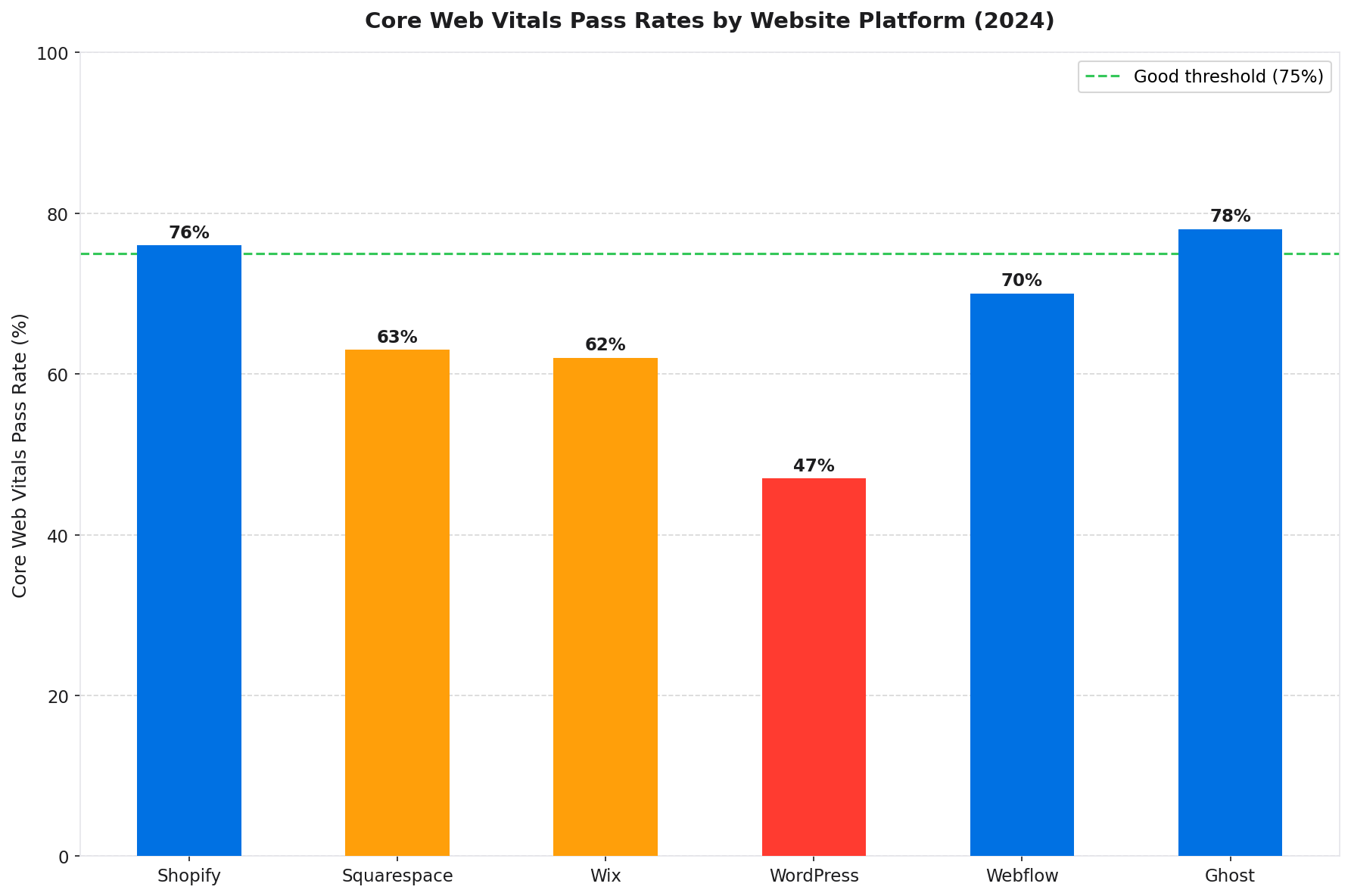
Platform choice shapes your SEO ceiling. A Shopify store can dominate its category with careful technical SEO, but it cannot change Shopify's URL structure. A WordPress site has the most flexible plugin ecosystem available, but requires ongoing maintenance that many teams cannot sustain. Wix has improved dramatically, but its JavaScript overhead creates real trade-offs in competitive niches. This guide compares SEO capabilities across Webflow, Shopify, Ghost, Squarespace, and Wix, giving you the information you need to choose the right platform for your ranking goals or to understand the constraints of the one you are already on.
Definition
Platform SEO capability refers to the combination of built-in SEO features, architectural constraints, and extensibility options that determine how effectively a website built on a given platform can be optimised for search engine visibility.
The website builder market reached $3.95 billion in 2024 and is projected to grow to $23 billion by 2031 at a CAGR of 28.6%, according to Cognitive Market Research via squarecode.promo. Wix leads with 40% market share (8.5 million sites), Squarespace holds 25% (5.3 million), and Shopify powers 5.2 million e-commerce sites at 19% share.
76%
Core Web Vitals pass rate for Shopify, the highest of any major platform
Source: Looker Studio data via squarecode.promo
Overview: The Five Platforms
Webflow targets designers and developers who want full visual control with clean code output. It has strong technical SEO defaults and is CMS-capable for content-heavy sites.
Shopify is the dominant e-commerce platform, with built-in product schema, a CDN-backed infrastructure, and a large app ecosystem for SEO tooling.
Ghost is a publishing-focused platform, fast by default, with canonical tags, sitemaps, and structured data out of the box. It has a smaller ecosystem but a focused, well-maintained codebase.
Squarespace is a design-first platform targeting small businesses and creatives. It has improved its technical SEO significantly in recent years but has notable limitations in URL control and custom code flexibility.
Wix is the largest website builder by site count. It has invested heavily in performance and now passes Core Web Vitals for the majority of its sites. Its JavaScript runtime remains a consideration for competitive niches.
Feature-by-Feature SEO Comparison
| Feature | Webflow | Shopify | Ghost | Squarespace | Wix |
|---|---|---|---|---|---|
| Custom meta titles/descriptions | ✓ | ✓ | ✓ | ✓ | ✓ |
| Custom URL slugs (full path) | ✓ | Partial | ✓ | Partial | ✓ |
| Custom structured data (JSON-LD) | ✓ | ✓ | Via code injection | Limited | Via Custom Code |
| Auto XML sitemap | ✓ | ✓ | ✓ | ✓ | ✓ |
| Canonical tags | ✓ | ✓ | ✓ | ✓ | ✓ |
| 301 Redirects | ✓ | ✓ | ✓ | ✓ | ✓ |
| Robots.txt access | ✓ | ✓ | Via config | Limited | ✓ |
| Internal link analysis tooling | Via Linki | Via Linki | Via Linki | Via Linki | Via Linki |
| Image optimisation (auto) | ✓ | ✓ | Ghost Pro only | ✓ | ✓ |
| HTTPS (auto) | ✓ | ✓ | ✓ | ✓ | ✓ |
Internal Linking Across Platforms: A Detailed Look
Internal linking is the SEO factor most consistently overlooked in platform comparisons. Every platform supports the ability to create hyperlinks between pages. What differs is the tooling, automation, and audit capability around those links.
As Ahrefs states in their SEO Basics guide: "Internal links help search engines find pages, pass PageRank, provide context." And according to Google's SEO Starter Guide: "Use links to connect users and search engines to other parts of your site; good anchor text describes the content of the linked page."
Definition
PageRank is Google's algorithm for measuring the importance of web pages based on the quantity and quality of links pointing to them. Internal links distribute PageRank between pages on the same site. Pages with more internal links pointing to them are treated as more important and tend to rank higher.
Here is how each platform handles internal linking:
Webflow: No built-in internal link suggestions. Manual linking via CMS templates (Collection Lists create automatic structural links). Linki provides audit capability. See the Webflow Blog SEO guide for setup instructions.
Shopify: Blog-to-collection and cross-collection links are manual. The platform has no internal link analysis. App ecosystem includes some SEO apps but none focused purely on internal link analysis. Linki fills this gap. See the Shopify SEO guide for a full internal linking strategy.
Ghost: Related posts via theme helper ({{#get "posts"}}) creates automatic structural links. All editorial linking is manual. No native audit capability. Linki is the recommended tool. See the Ghost CMS SEO guide.
Squarespace: Blog posts have a "Related Posts" block. No internal link audit capability. Custom code blocks allow manual link embedding.
Wix: No native internal link suggestions. Manual linking throughout. No native orphan detection. Linki provides full audit capability. See the Wix SEO guide.
Core Web Vitals Performance by Platform
Core Web Vitals (CWV) measure real user experience: loading speed (LCP), interactivity (INP), and visual stability (CLS). Google uses CWV as a ranking signal. Pass rates vary significantly across platforms.
According to data aggregated by squarecode.promo using Looker Studio data:
| Platform | CWV Pass Rate | Notes |
|---|---|---|
| Shopify | 76% | Highest of major platforms; CDN-optimised infrastructure |
| Squarespace | 63% | Improved significantly from 2022 baseline |
| Wix | 62% | 10x improvement in CrUX from 2020 investment cycle |
| WordPress | 47% | High variance depending on hosting/plugins |
Ghost and Webflow are not included in the same aggregated dataset but typically score in the 70–80% range based on their lightweight architectures and CDN-backed hosting.
Market Share and Platform Adoption
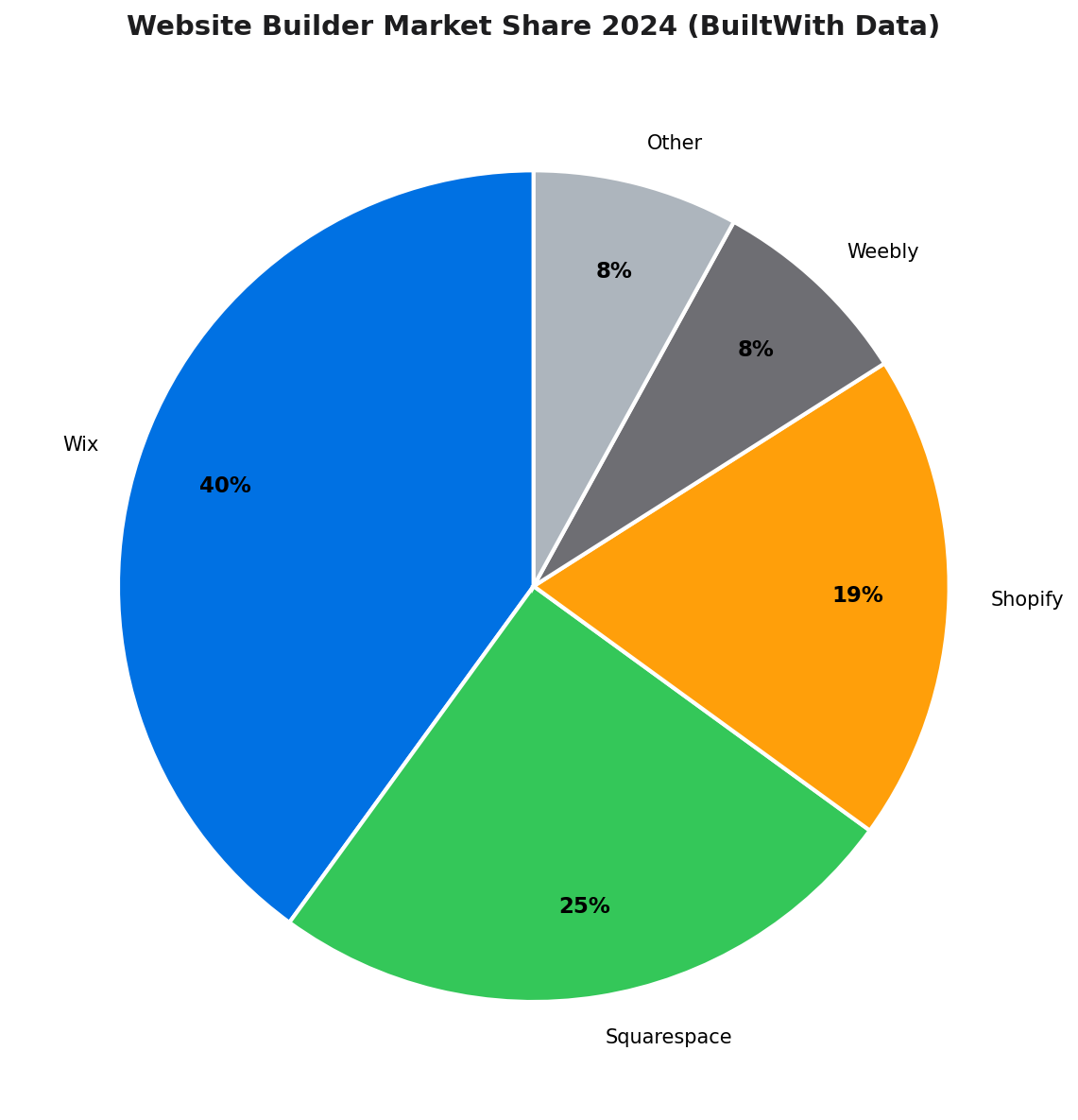
Market share reflects platform adoption, not SEO performance. Wix dominates by volume because it is the easiest to use for non-technical users. Shopify dominates e-commerce because its product management, payment processing, and app ecosystem are mature. Ghost and Webflow serve smaller but growing segments of professional users who prioritise performance and control.
"WordPress stands out for its vast array of plugins like Yoast SEO... great for both beginners and advanced users."
Dylan Cleppe, OneStop NW (20+ years digital experience), OneStop NW
$23B
projected website builder market size by 2031, growing from $3.95B in 2024 at 28.6% CAGR
Source: Cognitive Market Research via squarecode.promo
SEO Feature Matrix: Platform Scores Across Six Dimensions
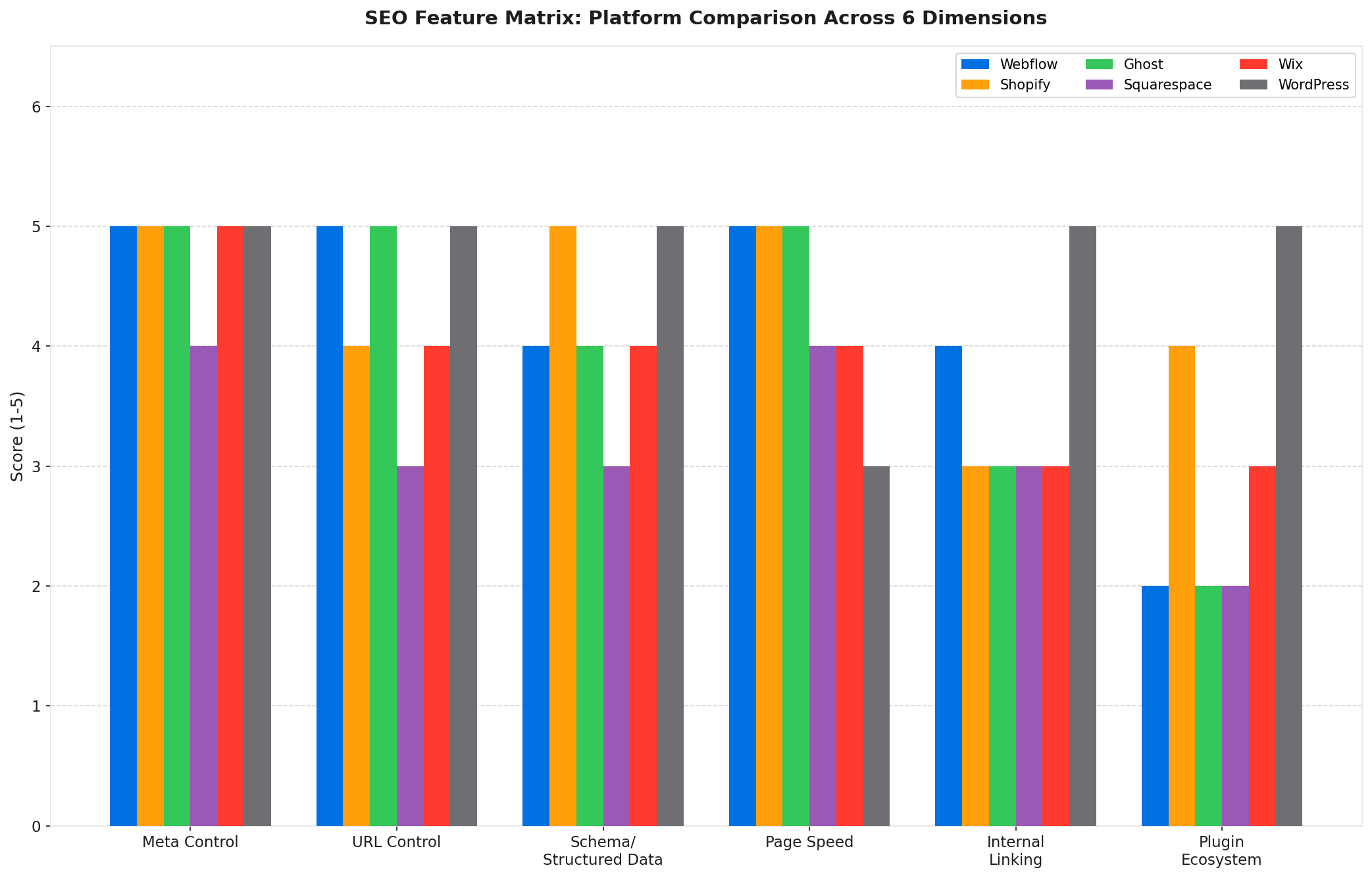
Across six dimensions, the platforms sort into clear tiers:
Highest overall SEO capability: WordPress (when properly maintained) offers the deepest feature set. Shopify leads in e-commerce-specific SEO. Webflow leads in design-control plus SEO combination.
Strong for focused use cases: Ghost for publishing and content-led SEO. Wix for SMB and local SEO with minimal technical overhead.
Moderate with notable gaps: Squarespace has improved substantially but still lags on custom code flexibility and plugin ecosystem depth.
28.6%
CAGR for the website builder market through 2031
Source: Cognitive Market Research via squarecode.promo
The Linki Advantage: Internal Linking Across All Platforms
The one SEO capability gap that cuts across every platform in this comparison is internal link analysis. No platform has native tooling to audit your complete internal link graph, identify orphaned pages, surface anchor text patterns, or recommend specific links to add.
Linki fills this gap. It works across Webflow, Shopify, Ghost, Squarespace, Wix, and WordPress sites, providing a unified internal link analysis that shows you exactly how link equity flows across your site and where pages are being cut off from that flow.
The platform you build on determines your starting point. Regular internal link auditing determines where you end up. These are complementary, not competing concerns.
Frequently Asked Questions
Which website builder has the best SEO tools in 2026?
For overall SEO capability, WordPress (with a quality SEO plugin) offers the most extensive feature set, including the deepest plugin ecosystem. For e-commerce SEO, Shopify leads with its product schema, CDN infrastructure, and 76% Core Web Vitals pass rate. For design-plus-SEO combinations, Webflow is the strongest choice. For publishing and content-led SEO, Ghost provides the best out-of-the-box SEO defaults. The "best" platform depends on your use case.
Webflow vs Shopify SEO: which wins?
For e-commerce, Shopify wins due to its purpose-built product schema, collection architecture, and extensive e-commerce SEO app ecosystem. For content-led businesses (blogs, portfolio sites, service businesses), Webflow wins due to its superior design control, clean HTML output, and CMS-driven metadata. For a business running both a content blog and an e-commerce store, this comparison becomes more nuanced.
Can Wix or Squarespace compete with WordPress for SEO?
For most SMB use cases, yes. Wix and Squarespace now handle the technical SEO basics reliably (HTTPS, sitemaps, canonical tags, image optimisation). Where they fall short is in the depth of custom code access, plugin ecosystem breadth, and control over server-level configuration. For competitive, high-volume SEO campaigns where every technical detail matters, WordPress with expert maintenance is still the more capable platform.
How does internal linking differ across platforms?
All platforms support creating hyperlinks between pages. The difference is automation and audit capability. Shopify and Ghost have some automatic internal link generation via their structural templates (collection pages, tag pages). Webflow's Collection Lists create automatic links within CMS structures. Wix and Squarespace have minimal automation. None of the platforms have native internal link audit tools, making external tooling like Linki necessary for any site serious about internal link optimisation.
What is the best platform for SEO if I am starting fresh in 2026?
If you are starting fresh in 2026, the choice depends on your primary use case. E-commerce: Shopify. Content/blogging: Ghost or Webflow. Local business or portfolio: Wix or Squarespace. General business or enterprise: WordPress (with technical support) or Webflow. In every case, the platform is only the foundation. Content quality, backlink acquisition, and internal link structure will determine whether you actually rank, regardless of platform.
Sources
- squarecode.promo, Website Builder Market Share Data
- Google, SEO Starter Guide
- Ahrefs, SEO Basics
- Sotion, Best Website Builders for SEO
- Hostinger, Best Website Builders for SEO
- OneStop NW, What is the Best Website Platform for SEO?
- Moz, On-Page Ranking Factors