
Journalists do not link to press releases. They link to data, stories, and expert commentary they cannot get elsewhere. Knowing how to give them that is what separates a digital PR campaign that earns twenty high-authority links from one that earns none.
This guide explains exactly how digital PR for SEO works, why it outperforms traditional link building, how to pitch effectively, and how to ensure the links you earn deliver maximum ranking impact through your site's internal structure.
Definition
Digital PR for SEO is the practice of creating newsworthy content, data, or commentary designed to earn editorial coverage and backlinks from journalists, publications, and authoritative websites. Unlike traditional link building, which often involves paid placements or link exchanges, digital PR earns links through genuine editorial interest.
What Is Digital PR?
Traditional PR focuses on brand awareness: press releases, product launches, event coverage. Digital PR shares those goals but adds a crucial SEO dimension. Every piece of coverage that includes a link to your website transfers domain authority from the publication to your domain. Over time, those links compound into a meaningful authority advantage.
The distinction matters because not all publicity creates SEO value. A radio mention does nothing for your rankings. A feature in a national newspaper with a dofollow link to your content is a significant asset. Digital PR targets the latter deliberately.
According to Ahrefs' guide to digital PR, page traffic correlates positively with the number of linking sites. The more authoritative sites linking to a page, the more organic traffic that page tends to receive. Digital PR is the most efficient way to earn those links at scale from high-domain-rating publications.
Why Journalists? The Case for Editorial Links
67.5%
Of companies believe link building substantially impacts SERP rankings
Source: DemandSage via Reboot Online Digital PR Statistics Report 2025
Editorial links from journalists carry more authority than almost any other link acquisition method. They come from established publications with large, engaged audiences and high domain ratings. They are contextually placed within relevant content. They are not paid for, which means they pass full equity rather than being tagged nofollow.
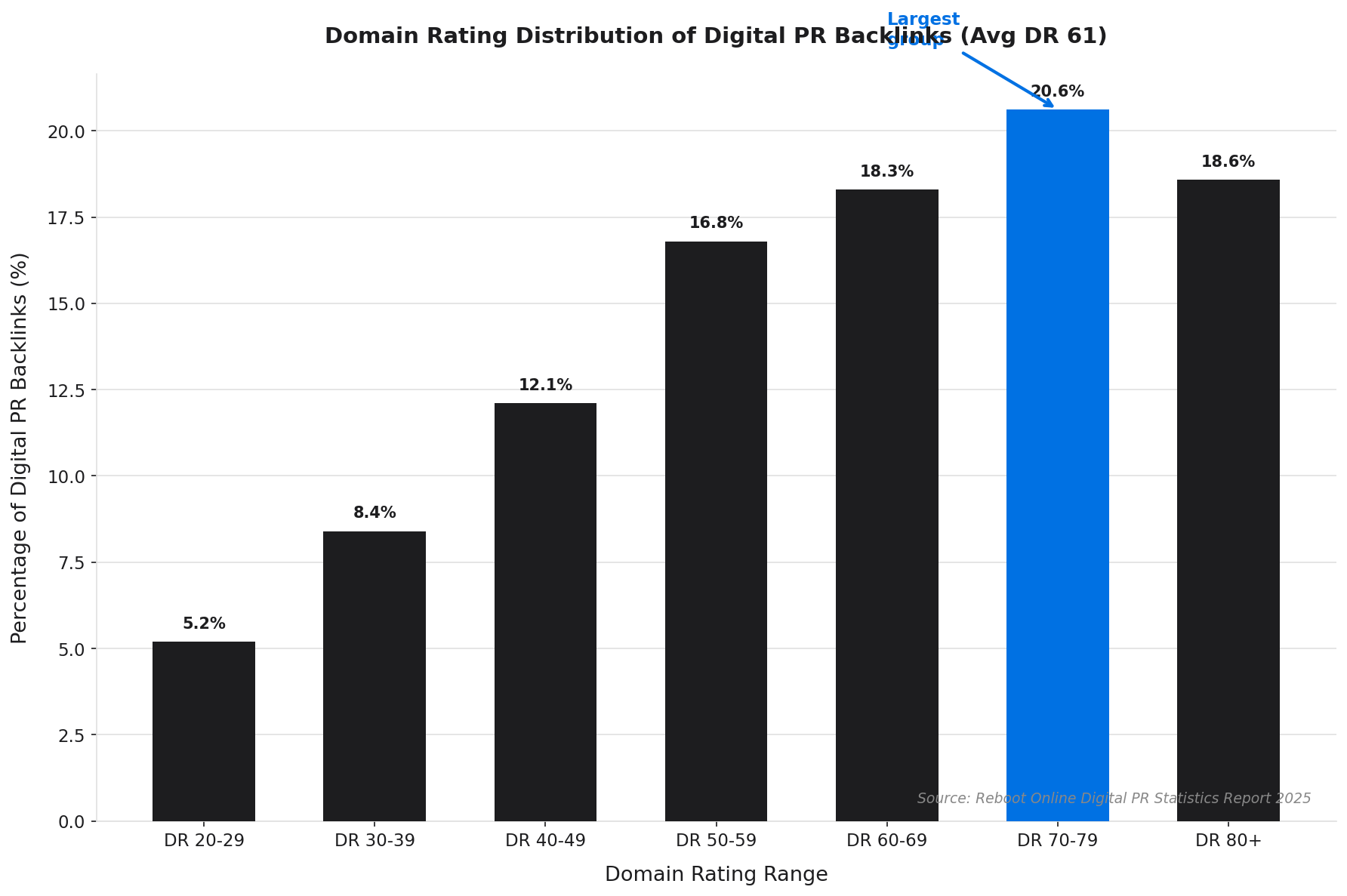
According to Reboot Online's 2025 Digital PR Statistics Report, 20.62% of digital PR backlinks come from sites with a Domain Rating of 70-79, with an average DR of 61 across all earned links. That is significantly higher than the average link acquired through traditional outreach or directory submissions.
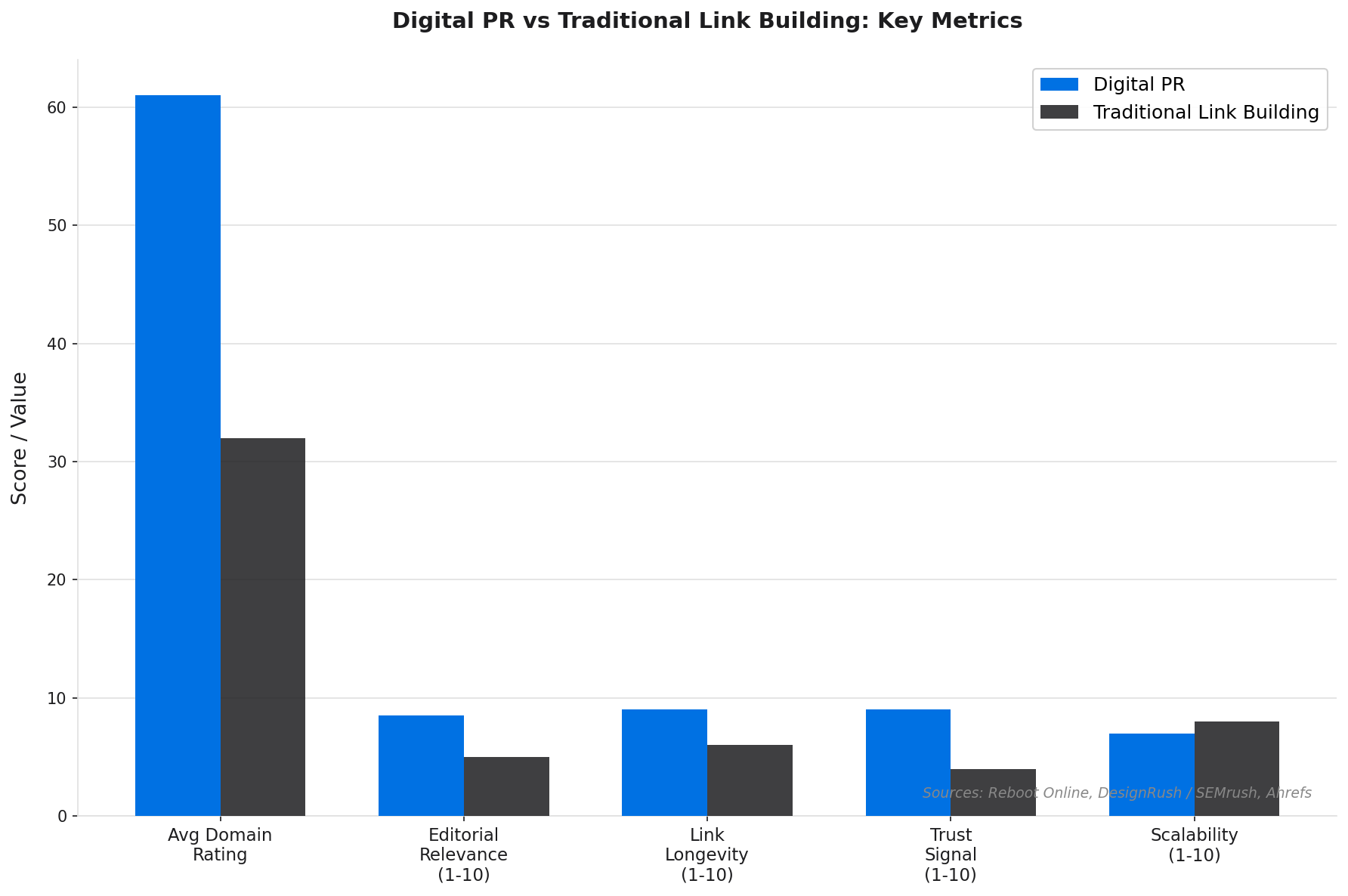
A further finding from DesignRush's SEMrush analysis shows that 43% of SEO teams report better backlink quality from digital PR compared to traditional link building methods. The quality gap is real and widening as Google increasingly rewards links that reflect genuine editorial judgement.
"Digital PR is often more important than technical SEO for establishing authority in competitive spaces."
John Mueller, Google Search Advocate
Digital PR Strategies for Link Building
There are three core content approaches that consistently earn journalist attention and editorial links.
1. Original Data and Research Studies
Journalists need data. Publishing original research gives them something to cite. A study of 1,000 customers, an analysis of industry trends, or a survey of professionals in your niche can generate dozens of links from publications that cite your findings.
The data does not have to be large-scale. A focused study with a surprising or counterintuitive finding is far more linkable than a comprehensive but predictable one. The key is exclusivity: if journalists cannot get this data elsewhere, they have a reason to link to you as the source.
2. Newsjacking and Reactive PR
Newsjacking involves responding to breaking news with expert commentary or supplementary data that journalists can use in their coverage. Speed is critical. The first credible expert voice to reach a journalist after a major story breaks often gets quoted and linked.
Set up Google Alerts and monitor industry news feeds. When a relevant story breaks, have your spokesperson ready with a comment within two to four hours. Tools like ResponseSource and HARO (Help a Reporter Out) also connect journalists with expert sources proactively.
3. Expert Commentary and Thought Leadership
Journalists regularly seek expert quotes to add credibility to feature articles. Building a reputation as a go-to expert in your niche means journalists come to you. This requires consistent public visibility: publishing opinion pieces, speaking at conferences, maintaining an active professional presence, and responding promptly to media enquiries.
43%
Of SEO teams report better backlinks from digital PR vs traditional link building
Source: SEMrush via DesignRush
Pitching Journalists: A Step-by-Step Approach
A poor pitch is deleted in seconds. A strong pitch gets a reply in minutes. The difference comes down to relevance, brevity, and timing.
Step 1: Identify the Right Journalists
Use tools like BuzzStream or Cision to find journalists who cover your topic area. Look at their recent articles to understand their angle and audience. Pitching a technology journalist about a retail story wastes both your time and theirs.
Step 2: Craft a Subject Line That Works
Your subject line is your only chance to earn an open. Keep it under 50 characters. Lead with the most interesting element of your story. Numbers, questions, and counterintuitive statements consistently outperform generic pitches. "New data: 67% of UK consumers trust AI recommendations" will outperform "Press release: Company announces study".
Step 3: Write the Pitch
The pitch itself should be no longer than 200 words. Open with the hook: the data point, the news angle, or the question your content answers. Explain briefly why it is relevant to their audience. Offer yourself as a source for comment and include a link to any supporting materials. Close with a clear call to action.
Step 4: Follow Up Once
A single follow-up email three to five working days after the initial pitch is appropriate. More than one follow-up damages your relationship with the journalist. Keep the follow-up brief: one sentence restating the hook, one asking if they have had a chance to review.
Step 5: Maintain the Relationship
Journalists who cover your niche are long-term assets. Engage with their work genuinely. Share their articles when they are relevant to your audience. Thank them when they cover your story. A journalist who has covered you once is far more likely to do so again.
Measuring Digital PR ROI for SEO
Measuring the SEO impact of a digital PR campaign requires tracking several metrics alongside traditional PR metrics like coverage volume and sentiment.
| Metric | What It Tells You | Tool |
|---|---|---|
| Number of linking domains | Breadth of coverage earned | Ahrefs / Moz |
| Average DR of linking domains | Quality of links earned | Ahrefs |
| Organic traffic to linked pages | Direct traffic impact | Google Search Console |
| Keyword rankings for target pages | Ranking improvement from links | GSC / Ahrefs |
| Domain Rating / Domain Authority | Overall authority gain | Ahrefs / Moz |
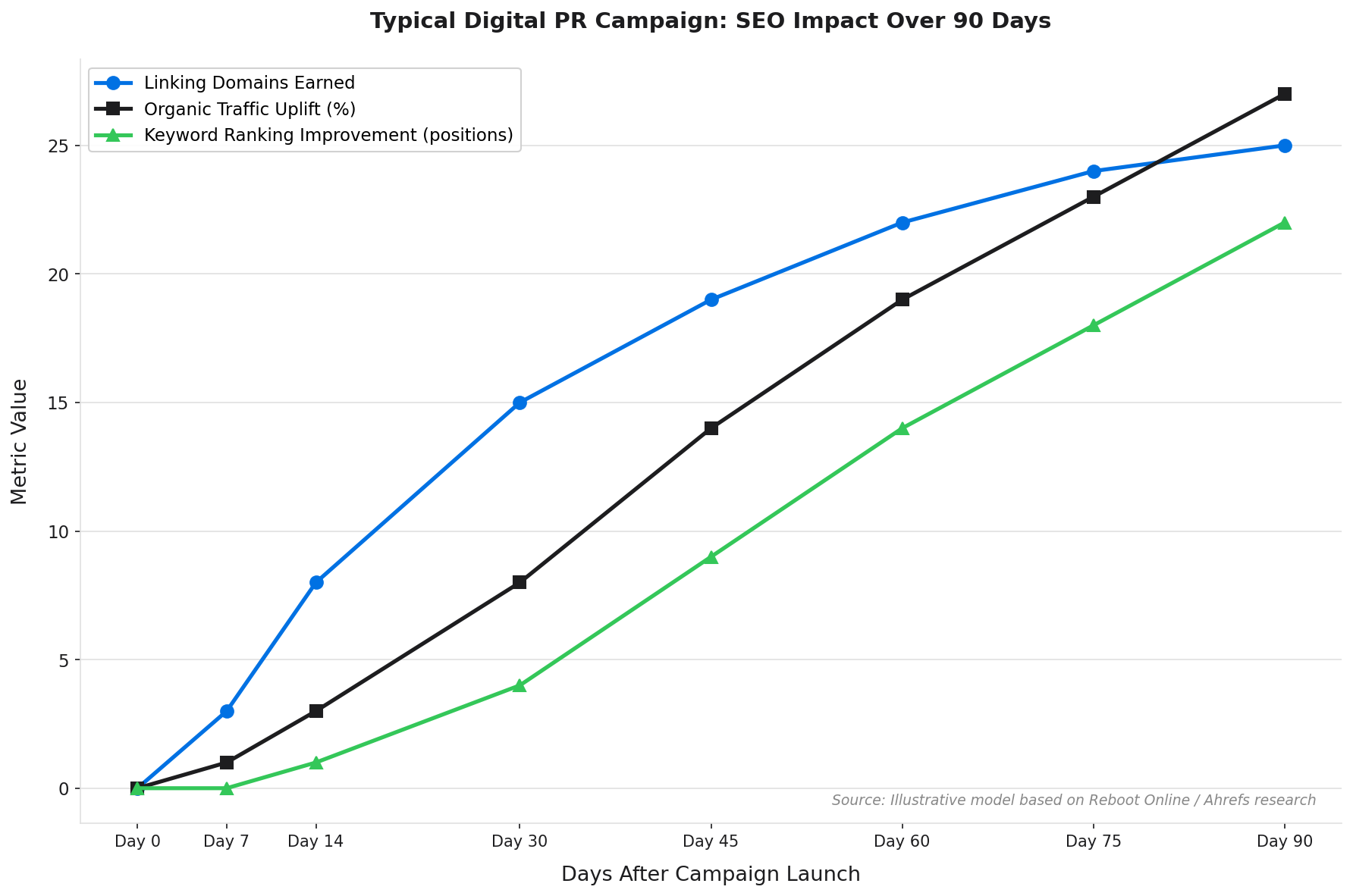
Track these metrics before and after each campaign. Set a baseline before you launch any outreach and record changes at 30, 60, and 90 days post-campaign. This gives you a clear picture of which content types and target publications drive the most SEO value.
The Hidden Multiplier: Internal Linking After Digital PR
Most digital PR guides stop at earning the link. That is only half the job. The page that receives the backlink distributes authority to the rest of your site through internal links. If that page has weak or no internal links pointing to your priority pages, much of the equity sits dormant.
This is where Linki makes a measurable difference. After each digital PR campaign, use Linki to:
- Check whether the page receiving the link has strong outbound internal links to your money pages.
- Identify which pages in your topic cluster the linked page should connect to for topical authority.
- Ensure that new coverage of a particular topic creates a clear internal pathway for users and crawlers alike.
- Audit the anchor text of existing internal links to and from the featured page.
A single well-planned digital PR campaign that earns ten links from authoritative publications, combined with optimised internal linking, can produce ranking improvements across dozens of pages on your site. See our guide on backlink strategies for the full playbook.
DR 61
Average domain rating of backlinks earned through digital PR campaigns
Source: Reboot Online Digital PR Statistics Report 2025
Frequently Asked Questions
What is digital PR and how does it help SEO?
Digital PR is the practice of creating newsworthy content or commentary to earn editorial coverage and backlinks from journalists and authoritative publications. It helps SEO by building high-quality backlinks that increase domain authority, improve keyword rankings, and drive referral traffic. Unlike paid link placements, editorial links pass full equity and carry significant trust signals.
How do you pitch journalists for backlinks?
Effective journalist pitches are brief (under 200 words), lead with a strong data point or news hook, and explain the story's relevance to the journalist's audience. Identify the right journalists using tools like BuzzStream or Cision, personalise each pitch, follow up once after three to five days, and invest in maintaining relationships over time.
What are the best digital PR strategies for link building?
The three most effective digital PR strategies for earning backlinks are: original data studies that journalists can cite, newsjacking by providing expert commentary on breaking news, and thought leadership positioning that makes you a go-to expert source. All three focus on giving journalists content they cannot find elsewhere.
How does digital PR compare to traditional link building?
Digital PR consistently earns higher-quality links than traditional link building methods. According to DesignRush analysis, 43% of SEO teams report better backlink quality from digital PR. Traditional methods like guest posting and directory submissions tend to produce lower-DR links that carry less authority and are easier for competitors to replicate.
How do you measure digital PR ROI for SEO?
Measure digital PR SEO ROI by tracking: number and quality of linking domains earned, changes in Domain Rating or Domain Authority, organic traffic to linked pages, and keyword ranking improvements for target terms. Set a baseline before each campaign and measure at 30, 60, and 90 days post-launch.
Sources
- Ahrefs, Digital PR for SEO: A Practical Guide
- Reboot Online, Digital PR Statistics Report 2025
- DesignRush, Digital PR Link Building Trends
- Energy PR, Digital PR Statistics
- Backlinko, Search Engine Ranking Factors
- Moz, Digital PR and Link Building
- BuzzStream, Digital PR Statistics
- Pure SEO, What Is Digital PR?
- The Hoth, Ultimate Guide to Digital PR