
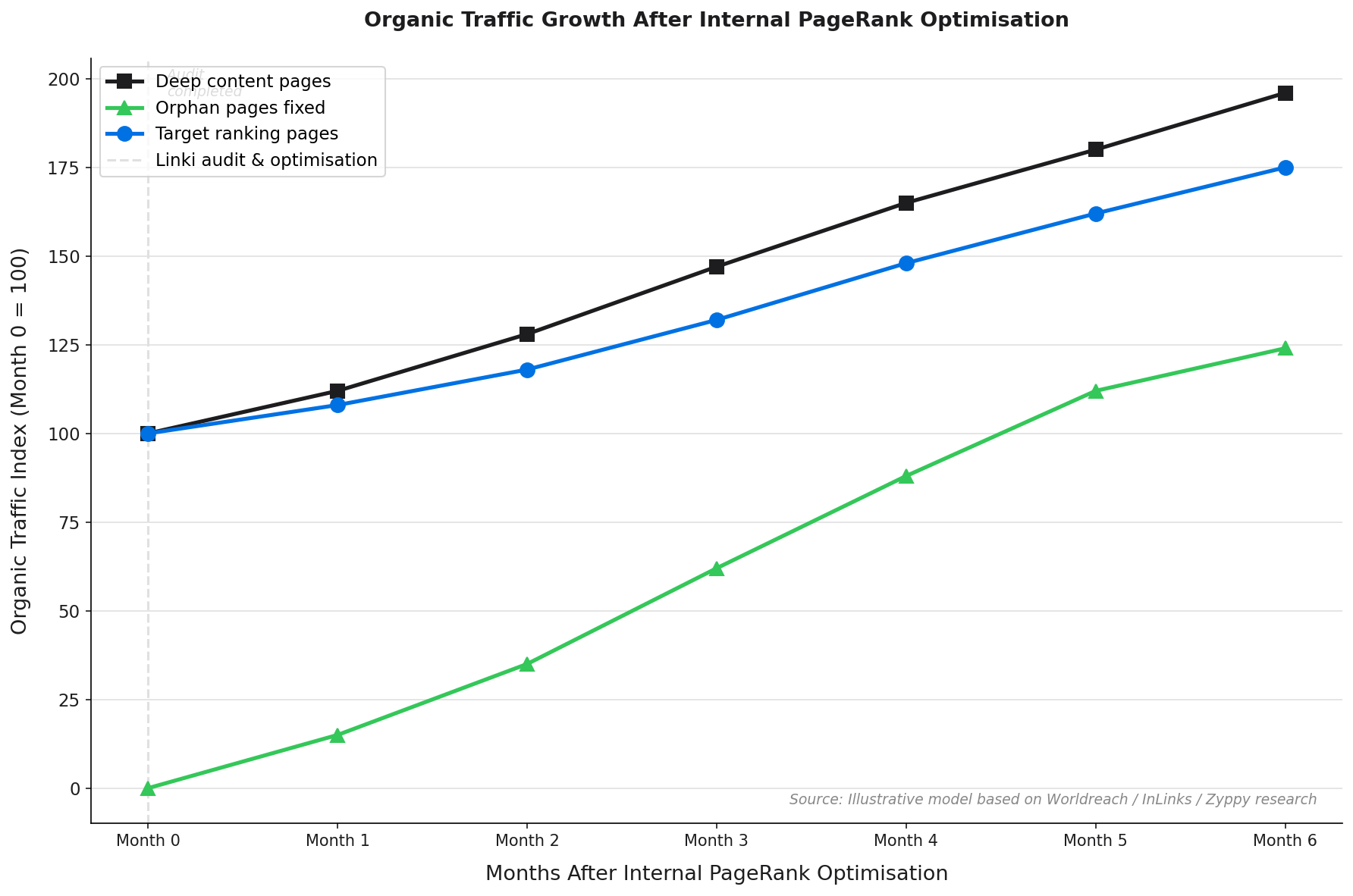
PageRank is the original Google algorithm. It was conceived at Stanford in the late 1990s and remains a core component of how Google evaluates pages today. Understanding how internal links pass PageRank gives you direct control over something most site owners leave to chance.
This article explains the mechanics of PageRank flow through internal links, the mathematical principles behind it, and the practical steps you can take to optimise your site's internal link structure for maximum ranking impact.
Definition
PageRank is a numerical value assigned to every web page that represents its relative importance within a link graph. It is calculated based on the number and quality of links pointing to a page, both from external sources and from other pages within the same site. Internal links distribute PageRank between pages on the same domain.
The Origins of PageRank
Larry Page and Sergey Brin introduced PageRank in their 1998 Stanford paper, "The Anatomy of a Large-Scale Hypertextual Web Search Engine". The core idea was straightforward: a page linked to by many high-quality pages is itself likely to be high quality. The algorithm quantified this intuition mathematically.
The basic PageRank formula is: PR(A) = (1-d) + d * (PR(T1)/C(T1) + ... + PR(Tn)/C(Tn))
Where PR(A) is the PageRank of page A, d is the damping factor, PR(T) is the PageRank of pages linking to A, and C(T) is the number of outbound links on each of those pages. The key variables are the damping factor and the number of outbound links, both of which directly affect internal linking strategy.
The Damping Factor Explained
Definition
The damping factor (d) in PageRank represents the probability that a random web user continues clicking links rather than starting a new session. Set at approximately 0.85, it means roughly 85% of a page's PageRank is passed to the pages it links to, while 15% is effectively lost at each step.
According to Wikipedia's PageRank article, the damping factor is typically set at 0.85. This has a critical practical implication: every link hop loses approximately 15% of the PageRank value. A page that is five clicks deep from a high-authority page receives significantly less PageRank than a page just one or two clicks away.
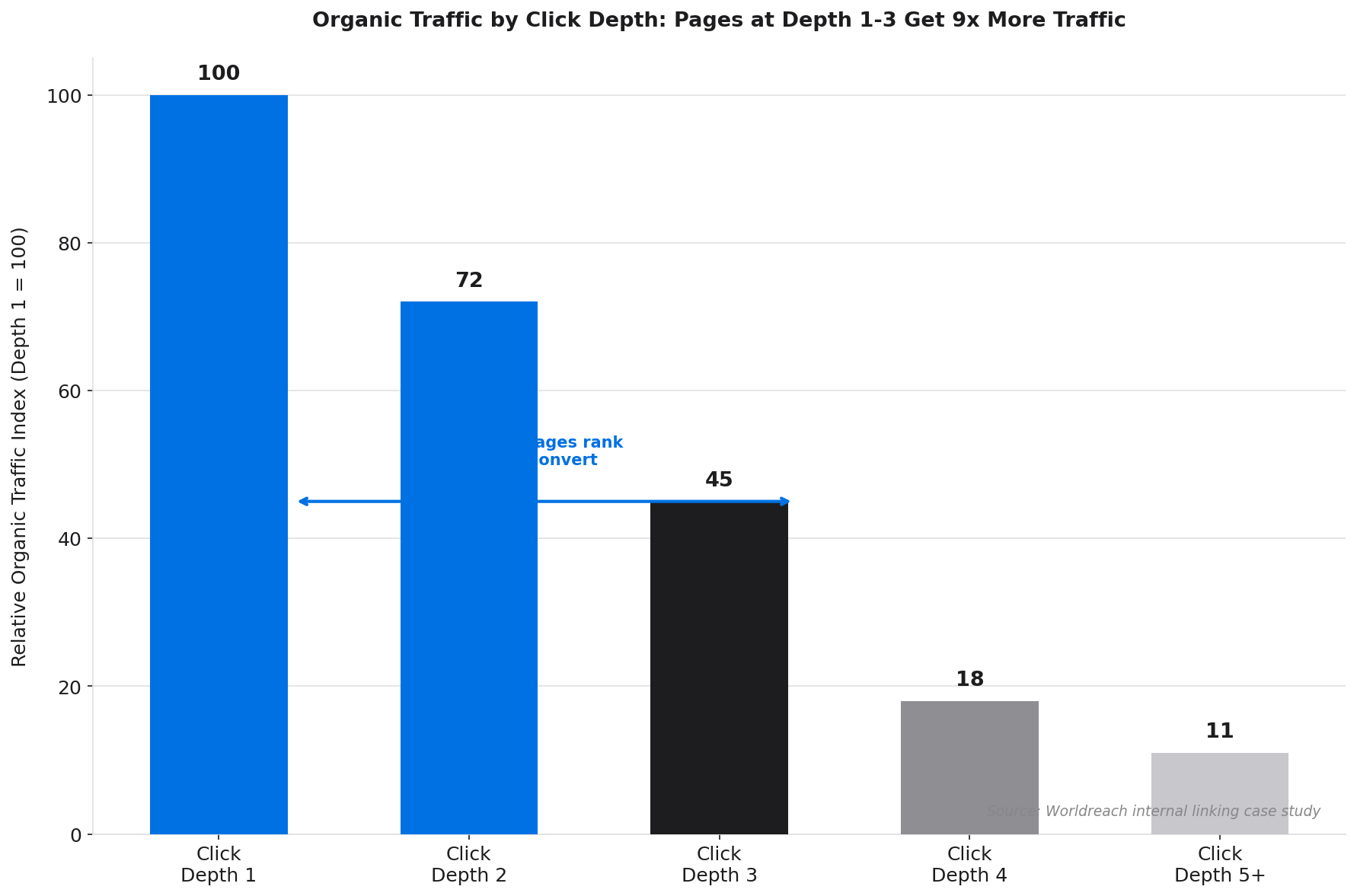
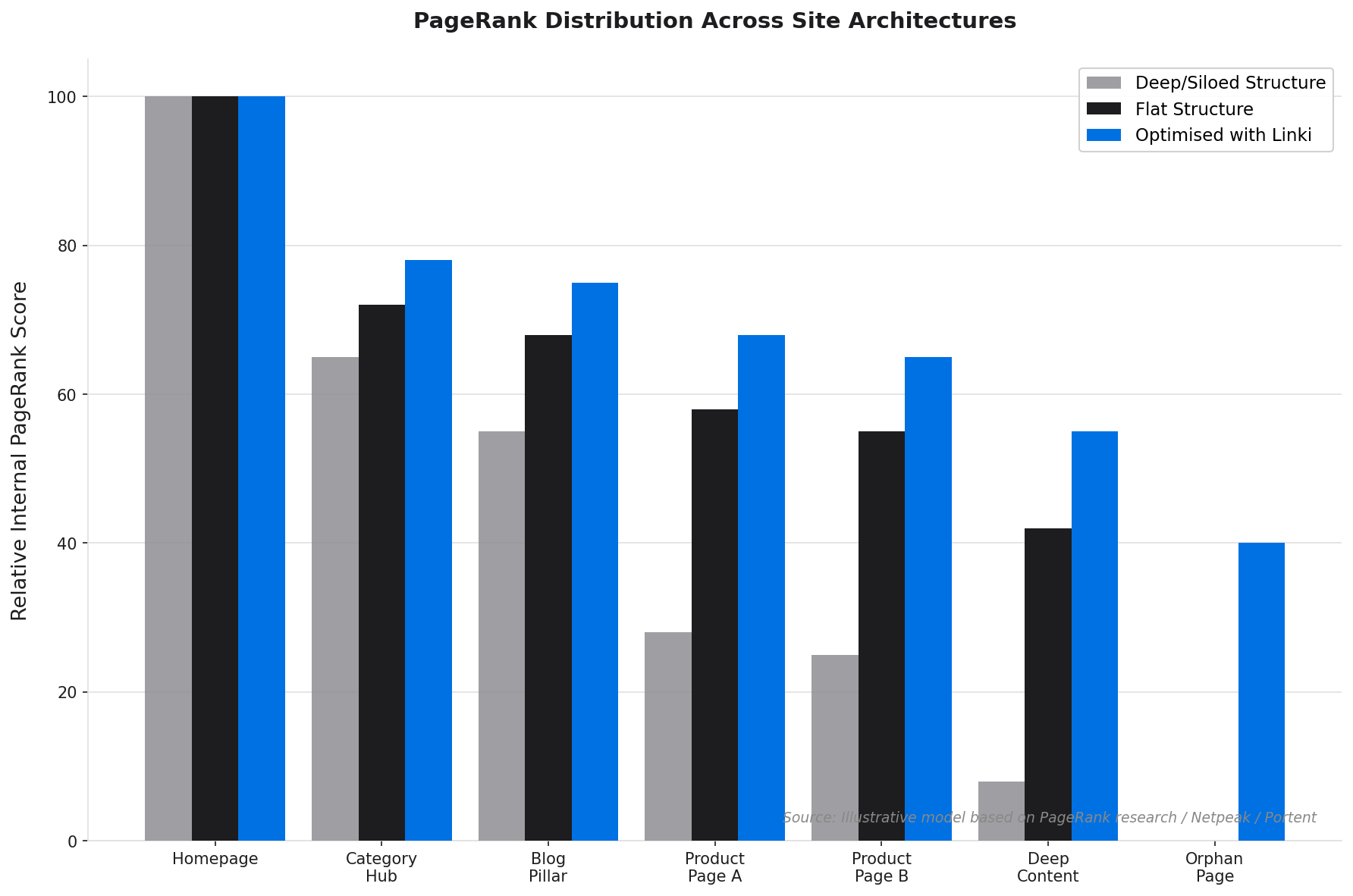
This is why site architecture matters so much. The deeper a page sits in your hierarchy, the less internal PageRank it can accumulate. Pages buried at click depth four or five may never receive enough internal equity to rank competitively, even if the domain has strong overall authority.
0.85
The PageRank damping factor: approximately 85% of equity passes through each internal link
Source: Wikipedia / Stanford PageRank Paper
Why Internal Link PageRank Matters for Rankings
PageRank from internal links is not merely a theoretical concept. The practical ranking impact is measurable and significant.
Research by Zyppy's SEO study found that pages receive a substantial traffic boost when they hold between 45 and 50 internal links pointing to them. There is a clear correlation between internal link count to a page and that page's organic traffic performance.
A case study from Worldreach found a 24% traffic lift from smart internal linking alone. The same study noted that pages at click depth one to three received nine times more organic traffic than those at greater depths. The damping factor effect is visible in real traffic data.
9x
More organic traffic on pages at click depth 1-3 vs pages buried deeper in site hierarchy
Source: Worldreach case study
Research by InLinks found that 82% of internal linking opportunities are missed by most sites. This represents a substantial pool of untapped PageRank distribution sitting dormant on pages that link to no other content.
"Internal PageRank is one of the most controllable and underutilised levers in technical SEO. Most sites are leaving significant ranking equity on the table simply through poor internal link structure."
Evan Hall, Portent SEO
Best Practices for Internal PageRank Optimisation
1. Reduce Click Depth for Priority Pages
Every page you want to rank competitively should be reachable within three clicks from the homepage. Use your navigation, breadcrumbs, and pillar page links to flatten your architecture. If a critical product or service page sits at click depth five, add a direct internal link from a high-authority page to reduce that depth immediately.
2. Link from High-Authority Pages to Target Pages
Internal links from your highest-PageRank pages pass the most equity. Your homepage, most-linked blog posts, and category hubs are all high-authority internal pages. Adding a contextual link from one of these to a lower-visibility target page is one of the fastest PageRank boosts available at zero cost.
3. Use Descriptive Anchor Text
Anchor text is not just a usability feature. It communicates relevance context to search engines. According to the Zyppy SEO study, pages with exact-match internal anchors receive five times more organic traffic than those without. Use keyword-relevant anchor text for every contextual internal link, while maintaining natural variation to avoid over-optimisation.
4. Fix Orphan Pages
An orphan page receives no internal links. It can only accumulate PageRank from external backlinks, and even those are limited without internal connectivity. Every orphan page on your site is leaking opportunity. Identify them using a site crawl tool or Linki, and immediately add at least one contextual internal link from a relevant, well-linked page.
5. Avoid Internal Link Dead Ends
A page that receives internal links but links to no other pages is a dead end. PageRank enters but cannot flow further. Ensure every page on your site has at least two or three relevant outbound internal links. This keeps equity circulating rather than pooling in isolated areas of your site.
Common Internal PageRank Problems
Siloed content with no cross-linking. Sites with strict category siloes can trap PageRank within individual sections. If your blog, product pages, and category hubs do not link to each other, each section accumulates authority independently rather than benefiting from the entire domain's equity pool.
Paginated content draining authority. Pagination creates deep pages that accumulate little internal PageRank. For large content sets, use a "view all" option or link to key paginated pages from a hub to ensure their content remains indexable and well-linked.
Too many links per page diluting equity. The PageRank a page passes to each linked page is divided by the number of links on that page. A page with 200 outbound links passes a fraction of the equity per link compared to a page with 20 links. Keep link counts reasonable: aim for fewer than 150 total links per page, as Moz recommends.
Redirect chains wasting equity. When a page is redirected, some PageRank is lost at each redirect step. A chain of three or four redirects can waste a significant portion of the equity that would otherwise reach the destination. Audit redirects regularly and replace chains with direct links where possible.
Using Linki to Optimise Internal PageRank
Manual PageRank auditing requires crawling your entire site, mapping the link graph, and calculating relative authority scores for each page. For sites with more than a few dozen pages, this is impractical without tooling.
Linki is built specifically to make this process accessible. Its internal link analysis engine:
- Maps the full internal link graph of your site to show which pages receive the most internal PageRank.
- Identifies orphan pages, dead ends, and pages at excessive click depth.
- Surfaces contextual linking opportunities between relevant pages with recommended anchor text.
- Shows which high-authority pages are not linking to any of your target ranking pages.
- Tracks changes in internal link structure over time so you can measure the impact of optimisations.
After using Linki to identify the highest-value opportunities, prioritise links from your most authoritative internal pages to the pages you most want to rank. This is the fastest way to shift internal PageRank distribution in your favour. See also our overview of topic clusters for the content architecture that makes this work at scale.
82%
Of internal linking opportunities are missed by most websites
Source: InLinks Internal Linking Research
Internal PageRank vs Backlink Authority: Understanding Both
PageRank flows through both internal and external links. Backlinks introduce authority into your domain from outside. Internal links distribute that authority once it arrives. Neither operates in isolation.
A useful mental model: backlinks fill the authority reservoir, and internal links are the pipes that carry that authority to each page. If your pipes are blocked or absent, the reservoir overflows on the pages that receive backlinks while priority pages remain dry.
This is why sites with strong backlink profiles still sometimes underperform expectations. The authority is present at the domain level, but poor internal linking means it never reaches the pages that need it. Conversely, a site with moderate backlinks but excellent internal linking can often outrank competitors with more raw authority but poor internal structure. Our comparison article on internal links vs backlinks covers this dynamic in detail.
Frequently Asked Questions
How does PageRank flow through internal links?
When a page links to another page internally, it passes a portion of its PageRank to the destination. The amount passed is divided by the number of outbound links on the page (so more links means less per link) and is subject to the damping factor of approximately 0.85. Pages with many inbound internal links from high-authority pages accumulate higher internal PageRank, which contributes to their ability to rank in search results.
What is the damping factor in PageRank?
The damping factor, typically set at 0.85, represents the probability that a theoretical random web user continues clicking links rather than stopping. In PageRank terms, it means approximately 85% of a page's PageRank is transferred through each link, while 15% is absorbed at each step. Over multiple hops, the cumulative effect of the damping factor significantly reduces the equity reaching deep pages.
Do internal links pass link equity?
Yes. Internal links pass link equity (PageRank) between pages within the same domain. The amount passed depends on the linking page's own PageRank, the number of outbound links on that page, and the damping factor. Contextual internal links within body copy are generally considered to pass more equity than navigational or footer links.
What is the optimal number of internal links per page?
Research by Zyppy found that pages with around 45-50 inbound internal links tend to perform best for organic traffic. For outbound internal links per page, keep the total under 150 (including navigation and footer links) to avoid excessively diluting the equity passed to each linked page. For contextual body links specifically, 2-5 per 1,000 words is a reasonable target.
How do I find and fix internal PageRank problems on my site?
Start by crawling your site with a tool like Screaming Frog or Linki to map your internal link graph. Identify orphan pages (zero inbound internal links), dead ends (pages that link to nothing else), and pages at click depth four or greater. Use a tool like Linki to surface specific contextual linking opportunities and prioritise adding links from your highest-authority pages to your ranking targets. Run this audit quarterly to maintain a healthy internal link structure.
Sources
- Stanford / Larry Page, Sergey Brin, The Anatomy of a Large-Scale Hypertextual Web Search Engine (1998)
- Wikipedia, PageRank
- Moz, PageRank: What It Is and Why It Matters
- Ahrefs, PageRank: Google's Original Algorithm Explained
- Zyppy, SEO Study: Internal Links and Traffic
- Worldreach, How Smart Internal Links Can Double Your Traffic
- InLinks, Internal Linking Opportunities Case Study
- Netpeak Software, Internal PageRank from A to Z
- Portent, Internal PageRank Optimisation Strategies