
Most link-building advice revolves around outreach: find prospects, send emails, hope for replies. Data-driven content takes a different approach. You create something so useful and citable that links come to you, often from publications that would never respond to a cold pitch.
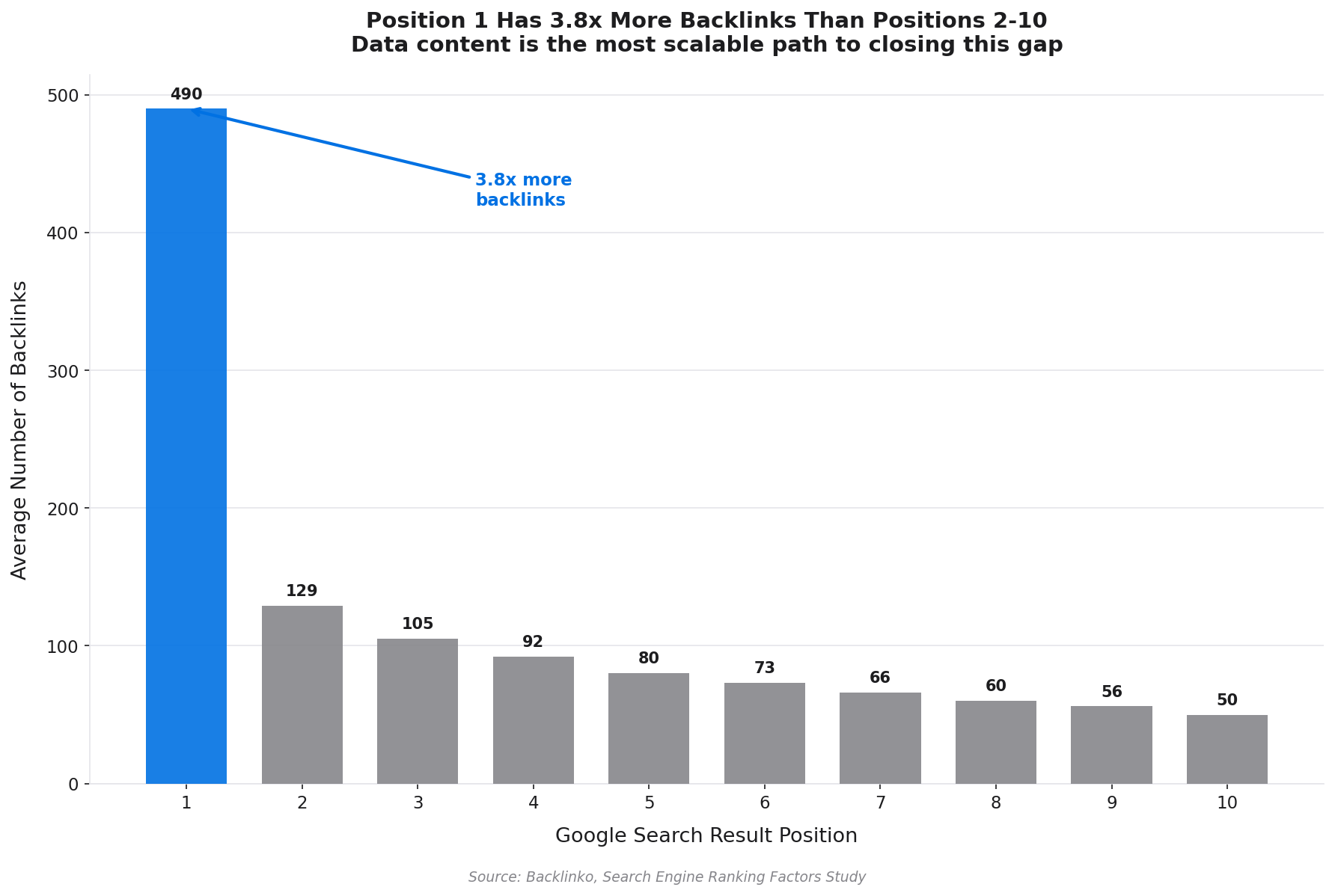
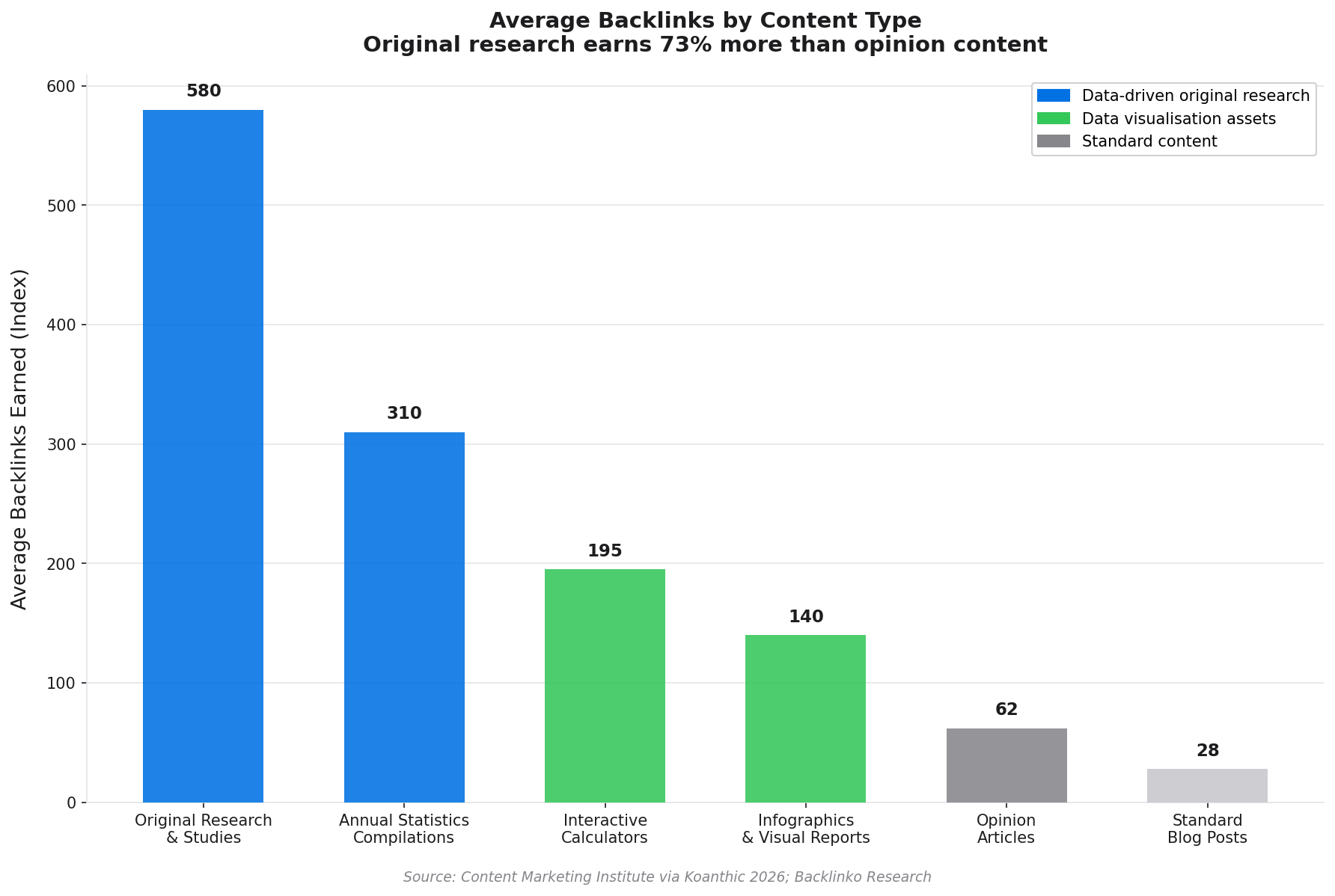
The evidence is strong. Original data content earns 73% more backlinks than opinion-based pieces.[1] And pages with more backlinks rank significantly better: the top result on Google has 3.8 times more backlinks than positions 2 through 10.[2]
Definition
Data-driven content is any piece of content that presents original or synthesised data to support its claims, typically through studies, surveys, statistics compilations, or data analyses. When this data is unique or freshly compiled, it becomes a citable asset that other publishers reference with a link.
300%
More backlinks generated by data-driven content versus standard content efforts
Source: Content Marketing Institute via Koanthic, 2026 Guide
What Types of Data Content Earn the Most Backlinks?
Not all data content attracts links equally. Format, freshness, and uniqueness all affect linkability. These are the categories that consistently outperform:
1. Original Industry Research and Studies
Conducting your own survey or study produces data that no one else has. Every publication that covers your topic will need to cite you if they want to use that data. Brian Dean's Backlinko study analysing 11.8 million search results earned over 5,000 backlinks purely through being the primary source of unique ranking data.[3]
2. Annual Statistics Compilations
Aggregating publicly available statistics into a single, well-organised, regularly updated page creates a citable reference. SEOs, journalists, and researchers link to these because they save hours of research. The key is committing to annual updates so the page stays authoritative.
3. Interactive Calculators and Tools
A calculator or quiz that solves a specific problem earns links naturally over time because it has ongoing utility. Unlike a one-time report, a tool continues to be useful and discoverable.
4. Visual Data Reports and Infographics
Well-designed infographics that present complex data visually are highly shareable. They work best when the underlying data is original or compiled from multiple sources into a single view that did not previously exist.
5. Benchmark Reports
Industry benchmark reports ("State of X" or "Annual X Report") become essential references for anyone writing about a sector. Companies like HubSpot and Salesforce have built significant link equity through annual benchmark publications.
How to Conduct Surveys for Linkable Research
Surveys are among the most accessible forms of original data creation. The barrier is lower than it appears.
- Define a specific, timely question. The more precisely you frame the research question, the more citable the result. "What percentage of UK SEOs run monthly internal link audits?" is more citable than "Do SEOs care about internal linking?"
- Choose your sample method. Options include: your own email list (fastest, smallest), paid survey panels (Pollfish, Typeform Audience), professional networks (LinkedIn, industry Slack groups), or partnering with a trade association for credibility.
- Aim for 200-500 qualified respondents minimum. Results from fewer than 100 people are difficult to publish credibly and easy to dismiss.
- Design for quotability. Include at least three statistics that can be pulled out as standalone data points. "X% of respondents reported Y" is the format journalists and bloggers use most.
- Publish with methodology transparency. Include sample size, survey dates, methodology, and any limitations. Credibility drives citations.
- Create a standalone statistics page. Separate from the full report, a stats page with each data point formatted cleanly makes it easy for others to cite individual findings.
"The most linkable pieces I have seen share one thing: a headline that ends a debate or settles a question people already argue about. Data that confirms a widely-held assumption is forgettable. Data that surprises gets cited."
Brian Dean, Backlinko
What Tools Analyse Competitor Backlinks for Gaps?
Before creating content, study what is already earning links in your space. This prevents you from producing something that competes with well-established resources.
| Tool | Primary Use | Backlink Gap Feature | Starting Price |
|---|---|---|---|
| Ahrefs | Backlink analysis, content research | Content Explorer + Link Intersect | $129/mo |
| Semrush | Full SEO suite | Backlink Gap tool (compares 5 domains) | $139/mo |
| Moz Link Explorer | Link research | Link Intersect | $99/mo |
| BuzzSumo | Content performance | Most-shared content by topic | $199/mo |
The practical workflow: enter three to five competitor domains into Ahrefs' Link Intersect or Semrush's Backlink Gap. Find sites that link to two or more competitors but not to you. Then look at which content types on those competitor sites earn the most links. This tells you what to create and who to pitch first.
Step-by-Step: Creating Data Content That Earns Links
- Identify a data gap. Use Ahrefs Content Explorer to search your topic and filter by "few backlinks but high traffic." These are areas where people search but existing content is thin on original data.
- Collect or commission the data. Sources include: Google Surveys, SurveyMonkey, Pollfish, publicly available datasets (ONS, Statista, Google Trends), academic databases, or your own product analytics if publishable.
- Structure around quotable findings. Lead with the most surprising or counter-intuitive finding. Write clear, numbered findings: "Finding 1: 96.55% of web pages receive zero organic traffic."[3]
- Design shareable visuals. Charts should have descriptive titles (not "Chart 1") and branded styling. Every chart should be embeddable independently.
- Publish with a complete methodology section. Include sample size, dates, data source, and any caveats. This is what separates citable research from opinion.
- Create a stats summary page. Separate from the full report, list each statistic in isolation with its source. This becomes the page journalists link to.
96.55%
Of web pages receive zero organic traffic from Google
Source: Ahrefs via Advanced Web Ranking
Promotion and Outreach for Data Content
Even the best data needs distribution. Organic discovery alone is rarely sufficient at launch.
Journalist and blogger outreach: Identify writers who have recently covered your topic using BuzzSumo or Google News. Reach out with a personalised pitch that highlights the most surprising finding, not the full report. Journalists want a hook, not a summary.
Industry newsletters: Many sector newsletters curate data and research. A brief pitch to the editor costs little effort and can drive significant referral traffic and links.
Social seeding: LinkedIn works especially well for B2B data. Post individual statistics from the study over several weeks, each with a link back to the full report.
Update and re-promote annually: Set a calendar reminder to update the data each year and re-pitch to your existing contact list. Annual updates create recurring link opportunities from the same content.
Why Integrate Internal Linking with Data-Driven External Strategies?
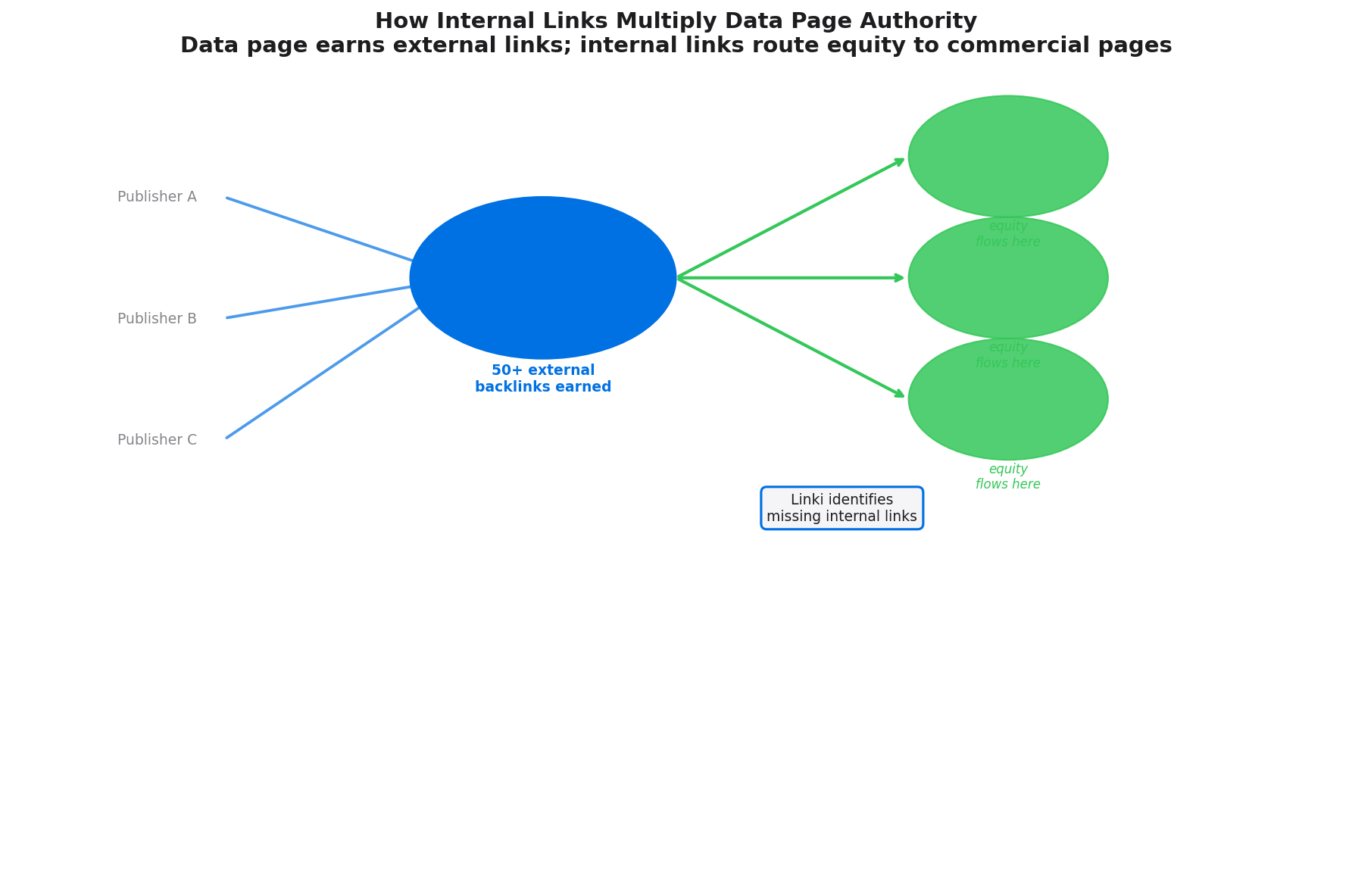
A data page that earns 50 backlinks is an asset. But unless that page links internally to your product, service, or commercial pages, the authority it accumulates stays on the data page.
The opportunity is this: your data pages often become your highest-authority pages. Properly linking from them to your commercial pages passes authority where it converts. See our link building strategy guide for how external and internal approaches complement each other.
Linki identifies which of your pages hold the most internal PageRank and which priority pages are under-served. After a data content campaign, the workflow is:
- Audit which pages gained the most backlinks from the campaign
- Use Linki to identify which commercial pages lack internal links from those high-authority data pages
- Add contextual internal links from the data page to the relevant commercial pages using descriptive anchor text
- Check for orphan pages within the same content cluster and link them into the network
This turns your data page into a double asset: it earns links externally and distributes authority internally. Read our topical authority guide for how content clusters amplify this effect.
Measuring and Refreshing Data Content
Track performance across three dimensions:
- Backlinks acquired: Monitor in Ahrefs or Moz weekly for the first month post-publication, then monthly
- Organic traffic: Set up Google Search Console tracking for the specific page
- Citation velocity: Use Google Alerts for the key statistic from the study (e.g., "73% more backlinks") to track who is citing you
The top-ranking pages for most queries have 3.8 times more backlinks than second-place.[2] Achieving that gap requires sustained data content output, not a single piece. Plan a quarterly cadence at minimum.
Frequently Asked Questions
What types of data content earn the most backlinks?
Original surveys and research studies consistently earn the most backlinks because they produce data no one else has. Annual statistics compilations, industry benchmark reports, and interactive calculators also perform strongly. The common factor is uniqueness: content that is the only source for a specific data point will attract citations indefinitely.
How do you conduct surveys for linkable research?
Define a specific, timely question; recruit at least 200 qualified respondents through paid panels, email lists, or professional networks; design questions that produce quotable percentage findings; publish with full methodology transparency; and create a separate stats summary page formatted for easy citation. Update annually to maintain relevance.
What tools analyse competitor backlinks for gaps?
Ahrefs' Link Intersect and Content Explorer are the most commonly used. Semrush's Backlink Gap tool compares up to five domains simultaneously. BuzzSumo identifies which topics in your space generate the most shares and links. The practical workflow is to identify sites linking to competitors but not to you, then study what content earned those links.
Why integrate internal linking with data-driven external strategies?
Data pages often become your highest-authority pages through earned backlinks. Without internal links from those pages to your commercial pages, the accumulated authority stays on the data page and does not support rankings where it matters for revenue. Internal linking ensures the authority from external links flows through your site strategically. Tools like Linki automate the audit of this flow.
How often should data content be refreshed?
Annual updates are the minimum for statistics and benchmark content. Set a calendar alert to refresh data, update charts, and re-promote to your outreach list each year. Outdated statistics lose citations over time as other publishers cite fresher sources. Quarterly updates are ideal for fast-moving sectors.
Sources
- Koanthic, Data-Driven Content Backlinks: Complete 2026 Guide
- Backlinko, Google's 200 Ranking Factors: Search Engine Ranking Factors Study
- Advanced Web Ranking, Data-Driven Link Building
- Ahrefs, Content Marketing
- Moz, Data-Driven Content