
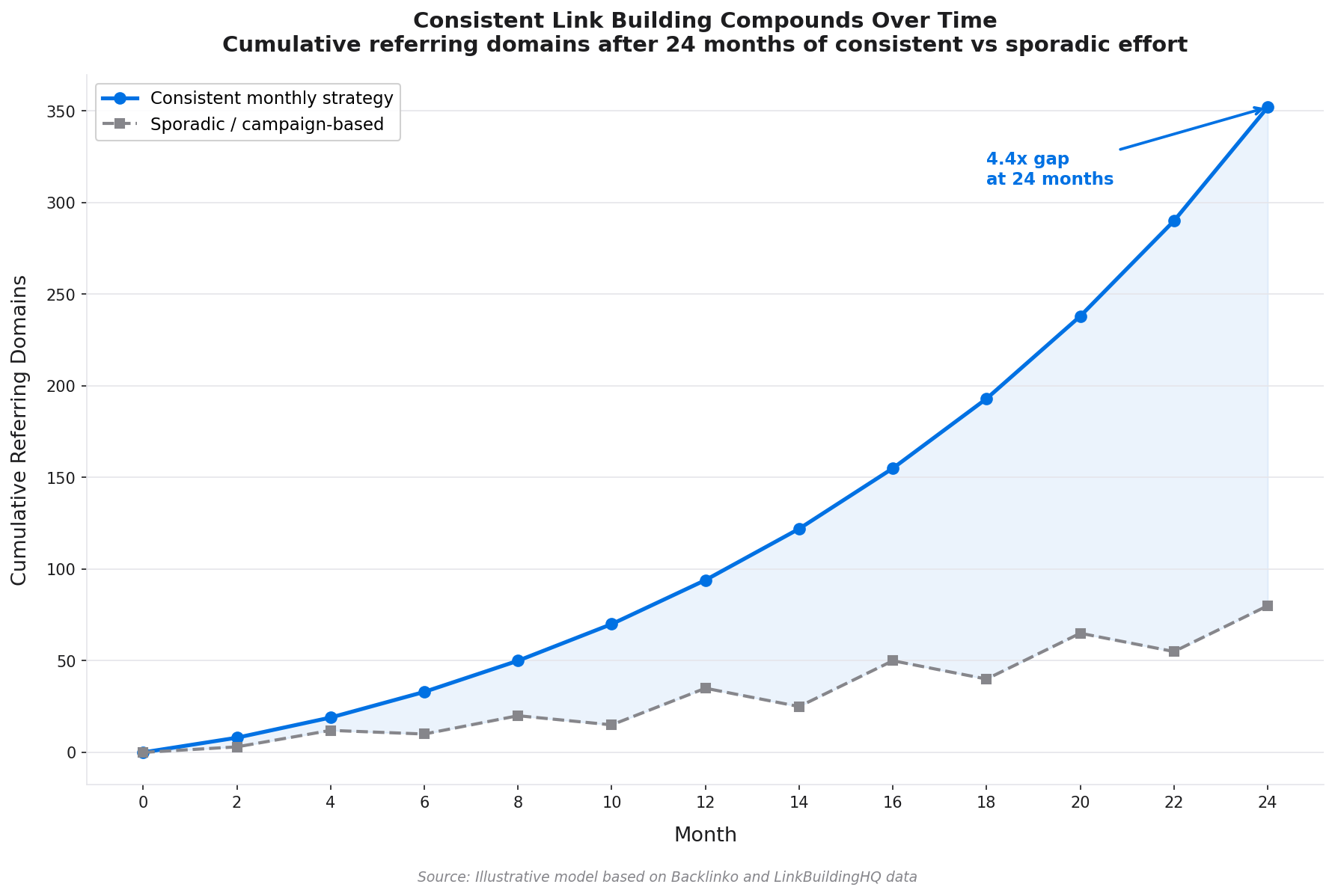
Backlinks remain the most consistent predictor of ranking position in Google's results. Pages ranking first have 3.8 times more backlinks than those in positions 2 through 10.[1] Having at least one backlink makes a page 77% more likely to appear in the top 10.[2]
In 2026, the mechanics of link building have not changed as dramatically as some claim. What has changed is the cost of getting it wrong. Google's spam policies are more aggressively enforced, AI-generated link schemes are detectable, and the gap between sites with genuine authority and those without continues to widen. This guide covers what works, what to avoid, and how to build a strategy that compounds over time.
Definition
Link building is the practice of acquiring hyperlinks from other websites to your own. In SEO, backlinks from authoritative, relevant sources signal to search engines that your content is trustworthy and worth ranking. A link building strategy is the structured plan through which a site systematically acquires these links over time.
What Is Link Building in SEO?
When one website links to another, it passes a signal of endorsement. Search engines, particularly Google, use these signals as one of the primary indicators of a page's relevance and authority. A page with many high-quality links from relevant, trusted domains is likely to rank higher than a comparable page with few or none.
The challenge is that links cannot simply be bought or manufactured without risk. Google's Link Spam policies explicitly prohibit schemes such as buying links, exchanging links reciprocally, and creating content solely for link building purposes.[3] Violations can result in manual penalties that remove a site from rankings entirely.
Effective link building therefore focuses on earning links through genuine value: content, relationships, and tools that other sites want to reference naturally.
78.1%
Of SEO teams report positive ROI from link building campaigns
Source: LinkBuildingHQ, Link Building Statistics 2026
Why Is Link Building Important in 2026?
Despite years of speculation that AI would make links obsolete, the data says otherwise. Link building delivered positive ROI for 78.1% of teams that practised it systematically in the most recent survey data.[2]
In 2026, three factors make a coherent strategy more important than ever:
- AI-generated content proliferation: As AI content saturates search results, differentiation through genuine authority signals (links from real sources) becomes a stronger ranking differentiator
- E-E-A-T emphasis: Google's increased emphasis on Experience, Expertise, Authoritativeness, and Trustworthiness means that signals of real-world authority, including links from respected publications, carry greater weight
- Compounding returns: Sites that built link profiles consistently over 3-5 years now hold positions that are increasingly expensive for competitors to challenge
Google's Link Policies: What to Avoid
Before building any strategy, understand the boundaries. Google's spam policies define link schemes as any links intended to manipulate rankings rather than serve readers.[3] The following practices carry significant penalty risk:
- Buying or selling links that pass PageRank
- Excessive link exchanges ("link to me and I'll link to you")
- Large-scale guest posting with keyword-rich anchor text
- Private blog networks (PBNs)
- Automated link building programmes
- Links embedded in widgets, templates, or footers at scale
Safe approaches earn links through merit: publishing content that others naturally reference, building relationships with journalists, or creating tools and resources that other sites want to recommend.
Creating Linkable Assets
The foundation of any sustainable link building strategy is content that other sites want to link to. Not all content qualifies. The most consistently linkable formats are:
Original Research and Data Studies
Content that produces data no one else has becomes a permanent citation source. Original data earns 73% more backlinks than opinion pieces.[4] Read our dedicated guide on earning backlinks with data-driven content for the full methodology.
Definitive Guides and Resources
Comprehensive, well-structured guides on important industry topics attract links from other content in the same space. They work best when they genuinely cover more ground than any existing resource. The key is genuine comprehensiveness, not length for its own sake.
Tools and Calculators
Interactive tools earn links naturally over time because they have ongoing utility. A well-built ROI calculator, benchmarking tool, or template library becomes a reference that writers recommend repeatedly.
Statistics and Data Compilations
Curated statistics pages that aggregate data from multiple primary sources save research time for writers and bloggers. These pages earn links continuously as people cite individual statistics.
Prospecting and Outreach
Even the best linkable assets need distribution. Outreach is the process of identifying potential link sources and reaching out to suggest your content as a relevant reference.
Identifying Prospects
Use Ahrefs' Link Intersect or Semrush's Backlink Gap to find sites that link to multiple competitors but not to you. These are warm prospects: they have already demonstrated a willingness to link in your space. Export the list, filter by domain authority (aim for DR/DA above 30 as a baseline), and check for topical relevance before reaching out.
Outreach Best Practices
- Personalise every email. Generic templates are immediately identifiable and ignored. Reference a specific piece of their content and explain precisely why your resource would benefit their readers.
- One ask per email. Do not combine multiple requests. Focus on a single, clear link placement suggestion.
- Follow up once. A single follow-up after 5-7 days significantly improves response rates. Two or more follow-ups damage your reputation.
- Track outcomes in a CRM or spreadsheet. Record contact, date, outcome, and any follow-up needed for every outreach attempt.
HARO and Media Outreach
Help a Reporter Out (HARO) and similar services (Qwoted, SourceBottle) connect journalists with expert sources. Responding with genuine expertise to relevant queries earns editorial links from publications that would never accept a direct pitch. This is one of the most scalable sources of high-authority links for B2B companies.
Advanced Tactics: Skyscraper, Broken Links, and Digital PR
The Skyscraper Technique
Developed by Brian Dean of Backlinko, the skyscraper technique involves finding content that has earned significant backlinks, creating a substantially better version, and reaching out to sites linking to the original. The key word is "substantially": incremental improvements do not motivate publishers to update their links. The new version must be noticeably more comprehensive, more accurate, or more recent.
Broken Link Building
Find broken links on relevant websites using the Ahrefs Broken Backlinks report or the Check My Links browser extension. When a site links to a resource that no longer exists, offer your content as a replacement. This gives the webmaster a genuine reason to act: they fix a broken link and get a relevant new resource in return.
Digital PR
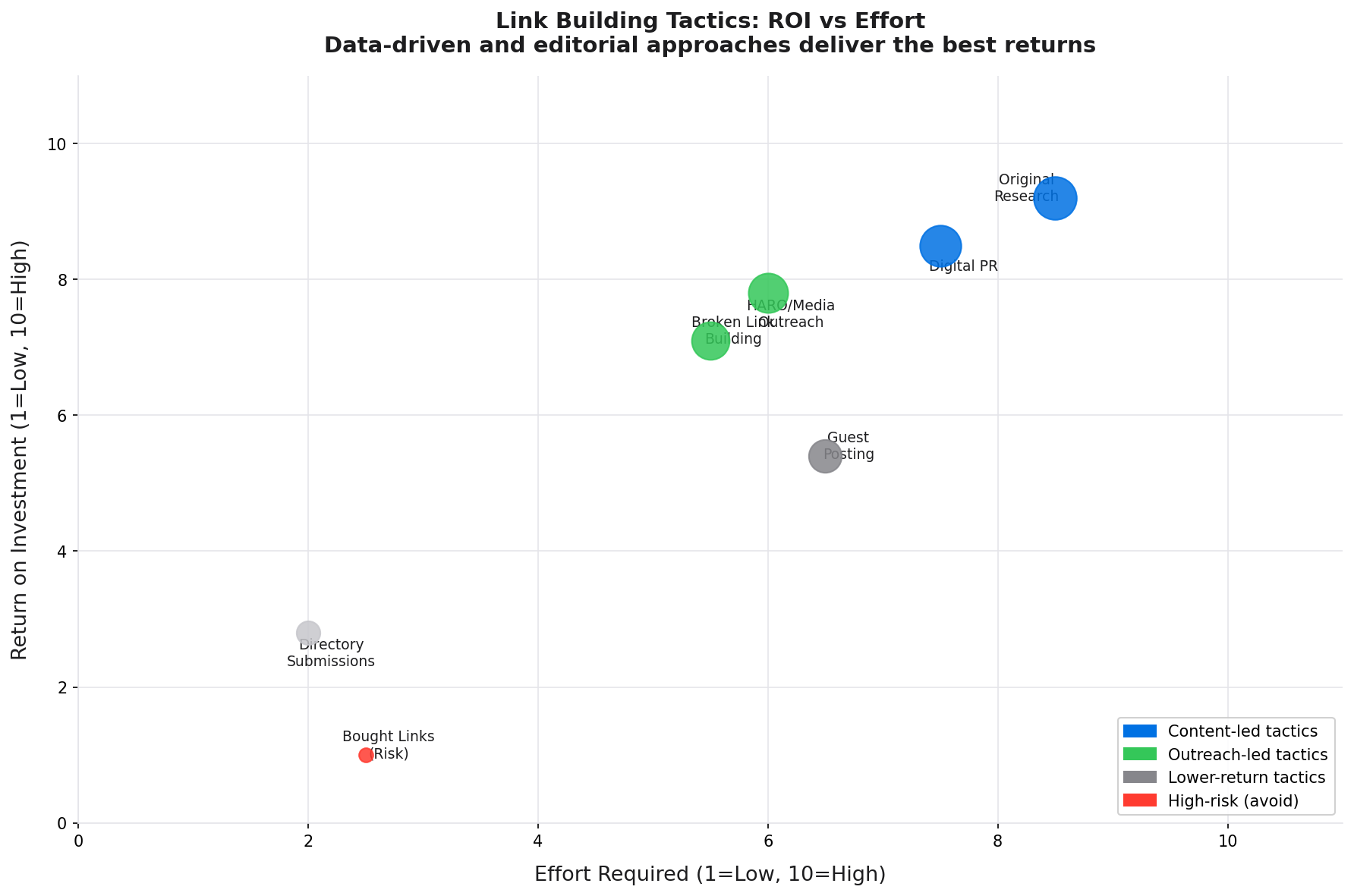
Digital PR involves creating newsworthy content or commentary specifically designed to earn coverage from journalists and publications. Data-led stories, reactive commentary on industry events, and creative campaigns that generate press coverage all produce high-authority editorial links. These links are the hardest to replicate and typically carry the most weight.
Resource Page Links
Many websites maintain resource pages that link to external tools, guides, and references in their niche. Find these using search operators (e.g., "your topic + useful resources" or "your topic + inurl:resources") and pitch your best linkable asset as a relevant addition.
Niche Edits
Niche edits (also called link insertions) place your link into existing, already-indexed content on relevant sites. When done legitimately, this means reaching out to publishers and requesting that your resource be added as a reference within a relevant section. Read our full breakdown in what are niche edits and should you use them.
Internal Linking: The Missing Piece of Most Link Building Strategies
Most link building guides stop at the point where the external link is earned. That omission is costly.
External links bring authority into your domain. Internal links determine where that authority goes within your site. A homepage that earns 200 backlinks but has no internal links to a key service page leaves that service page largely isolated from the authority the domain has accumulated.
This is the gap that Linki addresses. By auditing your internal link structure and identifying which pages are under-served by internal links, Linki ensures that every external link you earn contributes to ranking the pages that matter most for your business.
The internal linking strategy that complements external link building includes:
- Pillar-to-cluster linking: Your highest-authority pillar pages should link to supporting cluster content, distributing authority across the topic cluster
- Cluster-to-commercial linking: Content pages should link to commercial pages (services, products) where contextually relevant
- Orphan page elimination: Pages with zero internal links receive no authority from the rest of the site, regardless of how many external links the domain has
- Anchor text optimisation: Internal links should use descriptive, keyword-relevant anchor text that signals to search engines what the linked page is about
Our internal linking fundamentals guide covers the mechanics in detail. For the relationship between site structure and authority flow, see our site architecture guide.
Tools and Monitoring
| Tool | Primary Function | Best For |
|---|---|---|
| Ahrefs | Backlink analysis, prospecting | Link research and monitoring |
| Moz Pro | DA scoring, spam analysis | Prospect quality assessment |
| Semrush | Full SEO suite | Competitor backlink gap analysis |
| Google Search Console | Official link data | Tracking links Google has indexed |
| Hunter.io | Contact discovery | Finding editor and author emails |
| Linki | Internal link auditing | Distributing earned link equity internally |
77%
More likely to appear in the top 10 for pages with at least one backlink
Source: LinkBuildingHQ, Link Building Statistics 2026
Measuring Your Link Building Strategy
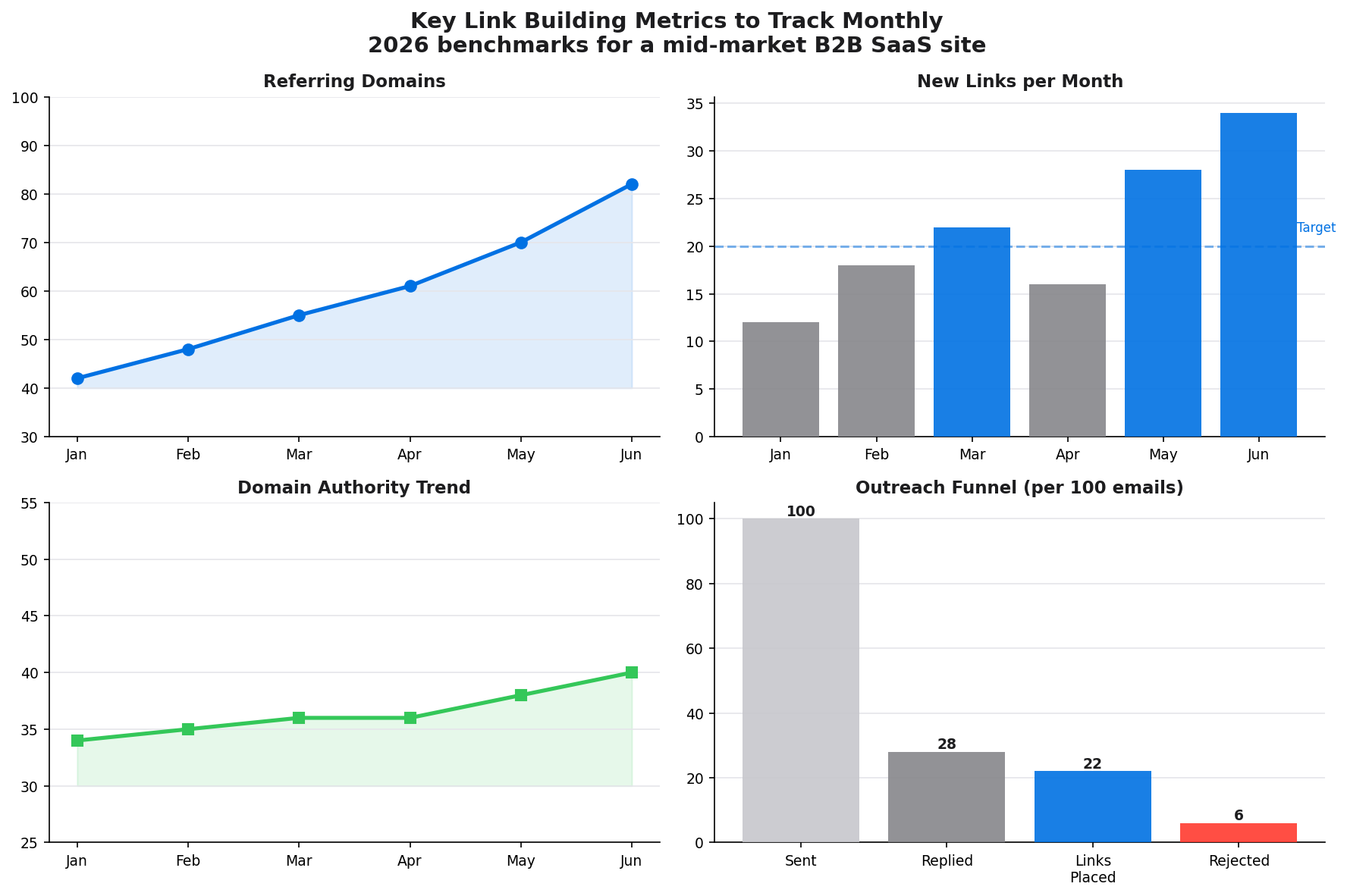
Track progress monthly across these core metrics:
- Referring domains: the number of unique domains linking to your site (more meaningful than total link count)
- Domain Authority / Domain Rating trends: a directional indicator of profile strength over time
- Organic keyword rankings: the ultimate measure of whether link building is translating to visibility
- Organic traffic: tracked in Google Search Console and Google Analytics
- Link velocity: the rate at which new links are being acquired (sudden spikes can look unnatural)
Review your backlink profile quarterly using Ahrefs or Semrush to identify and disavow any toxic links that have appeared. An unwanted pattern of spammy links pointing to your domain can suppress rankings even if you did not acquire them intentionally.
Frequently Asked Questions
What is link building in SEO?
Link building is the practice of acquiring hyperlinks from other websites to your own. Search engines use these links as signals of trust and authority, helping to determine where your pages rank in search results. Effective link building focuses on earning links from relevant, authoritative sites through quality content and genuine relationships rather than manipulation.
Why is link building important?
Backlinks remain one of Google's strongest ranking signals. Pages in position 1 have 3.8 times more backlinks than those in positions 2-10, and having at least one backlink makes a page 77% more likely to appear in the top 10. In 2026, as AI content becomes ubiquitous, genuine authority signals from real external links become more differentiated and valuable.
What are the most effective link building strategies?
The highest-returning strategies are: original research and data studies (which earn citations naturally); digital PR (editorial links from journalists); broken link building (replacing dead resources with your content); HARO/media outreach (earning expert source links); and resource page outreach. All are underpinned by having genuinely useful, linkable content assets.
How can I build links naturally without penalties?
Natural link building means earning links because your content is genuinely useful, not because you paid for or manipulated them. Focus on creating original research, comprehensive guides, and tools that others want to reference. Build real relationships with journalists, bloggers, and industry figures. Follow Google's Link Spam Policies and use the disavow tool proactively if your profile acquires suspicious links.
How does internal linking complement external link building?
External links bring authority into your domain. Internal links route that authority to specific pages. Without a structured internal link strategy, authority accumulates on pages like your homepage or blog archive and does not reach the service or product pages you need to rank. Tools like Linki audit internal link flow and identify which priority pages are being under-served, ensuring every external link you earn contributes to your actual ranking goals.
Sources
- Backlinko, Search Engine Ranking Factors Study
- LinkBuildingHQ, Link Building Statistics 2026
- Google, Google Search Spam Policies: Link Spam
- Koanthic, Data-Driven Content Backlinks: Complete 2026 Guide
- Moz, Beginner's Guide to Link Building
- Ahrefs, Link Building for SEO