Internal linking in 2026 is more important than it has ever been. That sounds counterintuitive. After all, Google AI Overviews now answer thousands of queries without a single click leaving the SERP, and Perplexity, ChatGPT Search, and Gemini are all synthesising answers directly from your content. So what exactly does your site's linking architecture have to do with any of that?
Everything. The very systems that appear to make your links irrelevant are, in fact, built on top of them.
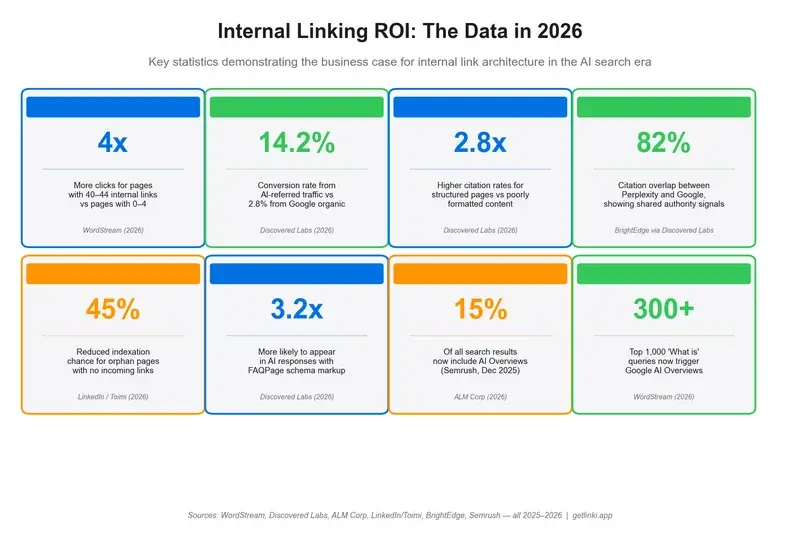
Over 300 of the top 1,000 "What is" queries triggered AI Overviews in early 2025, fundamentally changing top-funnel search behaviour.[1] Yet the sites earning citations from those AI systems share a common trait: coherent internal architecture that signals topical authority to machine-learning algorithms. Understanding what internal linking is and why it matters for SEO is the foundation every marketer needs before building for the AI era.
This article is the capstone of Linki's Pillar 1 series on internal linking strategy. It brings together what we know about traditional SEO, the December 2025 Google Core Update, and the emerging science of Generative Engine Optimisation (GEO) to give you a single, authoritative answer: yes, internal linking still matters in 2026, and the way you do it must evolve.
Definition
Internal linking in 2026 is the practice of connecting pages within a website via hyperlinks in order to signal topical relationships, distribute ranking authority, guide user journeys, and build the machine-readable semantic graph that AI search engines rely on when selecting sources for AI Overviews and generative citations.
Does Internal Linking Affect AI Overviews?
Yes. Internal linking directly affects your likelihood of appearing in Google AI Overviews, Google AI Mode, and third-party answer engines. Here is the mechanism.
Google's AI Overviews are generated using Retrieval-Augmented Generation (RAG): the system retrieves documents from its index, assembles them into context, and synthesises an answer. Pages that are well-connected within a coherent topical cluster are more likely to be retrieved, because the internal link graph signals to Google's systems that the site holds genuine, inter-related expertise on that subject.
- Well-structured sites with clear hub-and-spoke architecture make it easier for Google to identify topical authority.
- Internal links carrying descriptive anchor text signal relevance between pages, helping the algorithm understand subject matter at depth.
- Orphan pages receive no authority flow and are effectively invisible to AI retrieval systems.
- Coherent semantic clusters increase the chance that multiple pages from a single domain appear across an AI-synthesised answer.
Google's enhanced link visibility update of February 2026, which added hover-activated pop-up source cards to AI Overviews on desktop, confirmed that Google sees internal structure as a key input to AI source selection.[2] The sites being surfaced are those with the clearest topical architectures.
The Shift from "Link Juice" to Knowledge Graphs
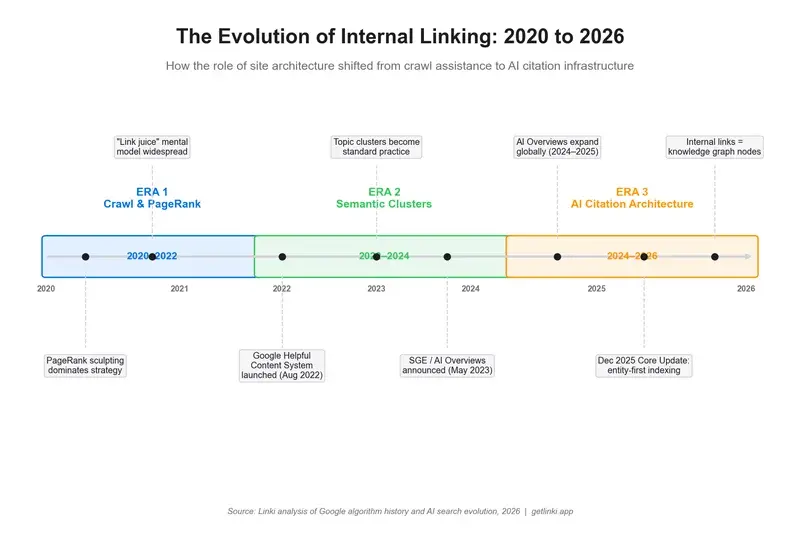
For years, the primary mental model for internal linking was PageRank sculpting: pushing "link juice" from high-authority pages toward pages you wanted to rank. That model is not wrong, but it is dangerously incomplete in 2026.
The December 2025 Google Core Update, which ran from 11 to 29 December 2025, represented a system-wide recalibration of how Google assesses content quality, entity recognition, and topical authority.[3] E-commerce sites saw 52% impact rates, health content 67%, and affiliate sites 71%.[4] The common factor in the sites that recovered or held their rankings was not more content; it was better content architecture.
What the December 2025 Update Changed About Internal Linking
The December 2025 Core Update changed internal linking in three ways. First, Google now evaluates topical authority at the site level, not just the page level. Clusters of well-linked pages on a topic outperform isolated, highly optimised single pages. Second, internal linking functions as a "strategic tool for authority distribution rather than simple navigational convenience", with semantic hubs and contextual linking significantly improving entity recognition.[3] Third, user engagement metrics, including internal link clicks, now carry increased weight as ranking signals.[4]
"Internal links help Google understand which pages are important on your site. They are one of the primary ways we understand the structure of your content."
John Mueller, Search Advocate, Google, via Hobo Web
What Mueller describes as "structure" is, in the language of 2026 SEO, a knowledge graph: a machine-readable network of entities and their semantic relationships. Your internal link architecture is the scaffolding of that graph. Understanding the difference between internal and external links is the starting point for building it correctly.
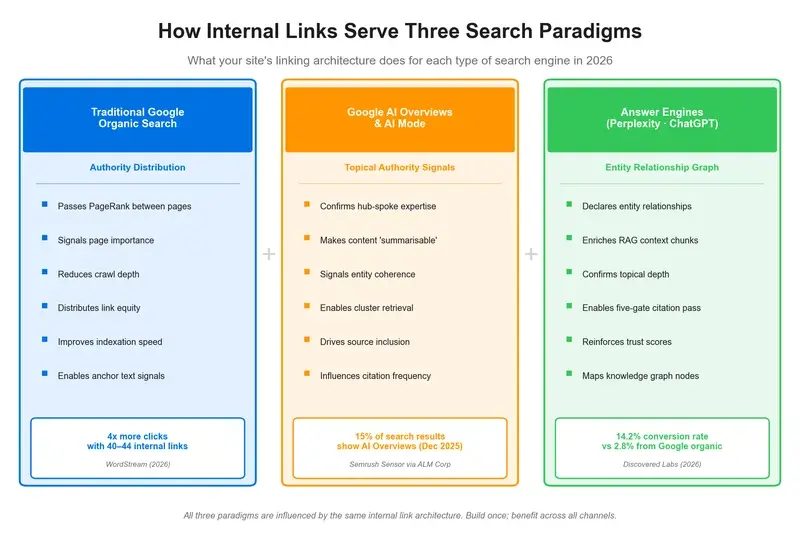
4x
More clicks seen by URLs with 40-44 internal links compared to pages with 0-4 internal links
Source: WordStream SEO Statistics (2026)
How Internal Linking Drives Generative Engine Optimisation (GEO)
Definition
Generative Engine Optimisation (GEO) is the practice of structuring content so that large language models (LLMs) and AI-powered search engines, including Google AI Overviews, Perplexity, and ChatGPT Search, can retrieve, extract, and cite it accurately. GEO sits alongside traditional SEO and AEO (Answer Engine Optimisation) as a distinct discipline requiring its own set of formatting, structure, and linking decisions.
LLMs do not rank pages the way Google's traditional algorithm does. They retrieve documents, chunk them into semantic units, and synthesise answers. The relevance of a document is assessed not just by its content, but by the richness of its contextual relationships. Internal links are the explicit declarations of those relationships.
A site with a tightly-linked content cluster on "internal linking strategy" sends a clear signal to retrieval systems: these pages belong together, they support each other, and the site holds substantive expertise on this topic. That consensus of interconnected evidence is precisely what AI engines look for when selecting sources to cite.
Feeding Google AI Overviews
Google AI Overviews use Gemini to synthesise answers from Google's live index. Site architecture and internal linking directly influence how Google understands topical authority and content relationships, and this topical authority signal plays a decisive role in AI Overview source selection.[2]
In practical terms, a clear hub-and-spoke content structure makes your site "summarisable". Google AI Overviews are, at their core, summaries. When your pillar page explicitly links to each supporting cluster article, and those cluster articles link back to the pillar, you create a self-contained knowledge module that the AI can confidently extract and condense. Learning to build a hub and spoke content model is the single highest-value structural investment you can make for AI visibility.
AI Overviews now appear in approximately 15% of search results, according to Semrush Sensor data from December 2025.[2] For informational queries, that figure is considerably higher. The sites earning inclusion are not those with the highest domain authority; they are those with the clearest, most coherent content architecture.
Optimising for Perplexity and ChatGPT Citations
How do you optimise internal links for Perplexity? Follow these steps:
- Ensure every page in your topic cluster links to and from the pillar page. Perplexity's retrieval system uses topical depth as a ranking signal; interconnected clusters signal genuine expertise.
- Use descriptive anchor text on every internal link. Vague anchors give retrieval systems no entity context. Specific anchors like "how to fix orphan pages" tell the system exactly what the target page covers.
- Add schema markup (FAQPage, HowTo, Article) to your hub pages. Pages with FAQPage markup are 3.2x more likely to appear in AI responses.[5]
- Keep paragraphs short (1-3 sentences). Perplexity's retrieval system chunks documents. Short, dense paragraphs make cleaner chunks and improve extraction accuracy.
- Ensure every linked page answers a question in its first 100 words. 90% of Perplexity's top citations follow the BLUF (Bottom Line Up Front) format, according to LLMClicks data cited by ZipTie.dev.[6]
The payoff for getting this right is substantial. AI-referred traffic converts at 14.2% compared to Google organic's 2.8%, according to Discovered Labs.[5] Pages with proper structural formatting earn 2.8x higher citation rates from Perplexity than poorly formatted content.[5] This is not marginal optimisation; it is a channel with meaningfully higher commercial intent.
14.2%
Conversion rate for AI-referred traffic vs. 2.8% for Google organic, making AI citation a high-value acquisition channel
Source: Discovered Labs, Perplexity Optimization Guide (2026)
The 3-Layer Architecture for 2026: Hubs, Spokes, and Bridges
The best internal link structure for 2026 is the hub, spoke, and bridge model. A hub page (your pillar) covers a broad topic comprehensively. Spokes (cluster articles) cover specific subtopics in depth, each linking back to the hub. Bridges are cross-cluster links that connect semantically related spokes across different hubs, signalling to AI systems that your site understands the relationships between topics at a granular level.
This three-layer model is the architecture described in depth in Linki's complete guide to internal linking strategy. Here is how each layer functions in the AI era:
| Layer | Page Type | Traditional SEO Role | AI/GEO Role in 2026 |
|---|---|---|---|
| Hub | Pillar / Guide | Collects and redistributes PageRank | Primary entity node; most likely AI Overview source |
| Spoke | Cluster / Supporting Article | Ranks for long-tail queries, feeds authority up | Deepens topical coverage; cited for specific subtopics |
| Bridge | Cross-cluster contextual link | Passes authority across topic silos | Establishes entity relationships across topics; enriches knowledge graph |
The bridge layer is what most sites are missing. Traditional SEO advice focussed on vertical authority flow, from spokes up to hubs and back. AI search requires horizontal entity relationships too. If your article on anchor text links only to your hub page and nothing else, you are missing the opportunity to tell Perplexity that anchor text strategy connects to orphan page fixing, crawl optimisation, and content cluster architecture. These contextual bridges are how LLMs understand the full scope of your expertise.
Anchor Text in the Era of Semantic Search
Anchor text has always been a relevance signal. In the semantic search era, it is now an entity declaration. When you link to a page about fixing orphan pages with the anchor text "read more", you are telling Google and Perplexity absolutely nothing about what that page covers. When you link with the anchor "how to fix orphan pages with internal links", you are explicitly assigning the page to the entity "orphan page remediation" within your knowledge graph.
Generic anchors do active harm in 2026. They create ambiguity in the entity graph. AI retrieval systems have to rely on the target page's content alone to determine relevance, without the confirming signal of descriptive anchor text from multiple sources. The result is lower topical authority scores and reduced likelihood of citation.
Cyrus Shepard's ongoing research at Zyppy consistently demonstrates that internal link anchor text is one of the strongest explicit signals of a target page's subject matter. The principle holds equally for AI retrieval: descriptive, varied, and natural anchor text creates a richer entity map. The complete guide to anchor text for internal links covers the full taxonomy of anchor types and when to use each.
| Anchor Text Type | Example | SEO Signal | AI Entity Signal | Verdict |
|---|---|---|---|---|
| Exact match | internal linking strategy | Strong | Strong | High |
| Partial match | our guide to internal links | Good | Good | High |
| Branded | Linki's linking tool | Moderate | Moderate | Medium |
| Generic | click here, read more | Negligible | None / negative | Low |
| Naked URL | getlinki.app/blog/strategy | Low | Low | Low |
The Hidden Danger of Orphan Pages in 2026
An orphan page is a page with no incoming internal links. In traditional SEO, it ranks poorly because it receives no PageRank. In 2026, the problem is more severe: orphan pages do not exist in your site's knowledge graph at all.
Industry analysis suggests a page without incoming links loses up to 45% of its chance of remaining indexed over time.[7] For AI retrieval systems, the effect is even more binary. Perplexity's citation model requires content to pass a five-gate gauntlet: intent matching, retrieval, quality assessment, ML reranking, and engagement signals.[6] A page that is not discoverable through internal links fails at gate one. It is not cited; it is simply not retrieved.
82%
Citation overlap between Perplexity and Google for healthcare queries, showing that traditional authority signals (which internal links build) feed directly into AI visibility
Source: BrightEdge research, via Discovered Labs (2026)
The 82% citation overlap between Perplexity and Google for healthcare queries, reported by BrightEdge and cited by Discovered Labs, is one of the most important statistics in modern SEO.[5] It tells us that the authority signals Google uses to rank content are substantially the same signals Perplexity uses to cite content. Internal links build those authority signals. Fix your orphan pages, and you improve your rankings in both paradigms simultaneously.
Manually hunting for orphaned content on a growing site is practically impossible at scale. Linki automatically flags pages that have dropped out of your semantic graph, ensuring your best content does not get ignored by AI retrieval systems. The complete playbook for fixing orphan pages with internal links walks through the full remediation process.
"Pages connected through multiple paths get crawled more frequently. Pages with few or no incoming links might get crawled rarely or never."
ClickRank, Internal Linking Structure: The Ultimate 2026 SEO Guide
Human Experience vs. AI Generation: The 2026 Balancing Act
There is a tension at the heart of 2026 internal linking strategy. Optimising for AI retrieval systems pulls you towards short paragraphs, dense entity declarations, and schema markup. Optimising for human readers pulls you towards narrative flow, contextual relevance, and genuinely useful navigational pathways. The best sites do both simultaneously.
Your internal links serve two entirely different masters. For AI systems, they are semantic declarations. For humans, they are signposts. A link to "contextual vs navigational links" in this paragraph serves a Perplexity query about link types and also tells a human reader where to go if they want to understand when each link type is appropriate. These goals do not conflict; they reinforce each other.
The December 2025 update specifically weighted behavioural signals including internal link click rates as ranking factors.[4] This means links that humans actually click, because they are placed at the right moment in the right context, are also the links that improve your SEO performance. The commercial imperative is the same as the technical one: put useful links where readers want them.
The guide to contextual links versus navigational links covers the specific decisions involved in balancing these two functions across different page types and user journeys.
AI Content and the Authenticity Signal
The flood of AI-generated content in 2025 created a new challenge: Google is now better at identifying content that lacks human expertise, original insight, and genuine first-hand experience.[4] Sites that publish at volume without maintaining human quality signals are being penalised. Internal linking, done thoughtfully, is itself an authenticity signal: it demonstrates that a human has read the content, understands its relationship to other material on the site, and has made deliberate editorial decisions about which pages connect.
Programmatic internal linking tools that auto-insert links by keyword matching miss this nuance. The quality of a link, its placement in a natural reading context, the precision of its anchor text, and the relevance of its target are signals of editorial judgment that AI quality assessors are increasingly able to detect.
2.8x
Higher citation rates earned by pages with proper structural formatting compared to poorly formatted content
Source: Discovered Labs, Perplexity Optimization Guide (2026)
The Practical 2026 Internal Linking Audit Checklist
Strategy without implementation changes nothing. Here is the checklist used by Linki's power users to bring their site architecture into alignment with 2026 requirements.
| Task | Why It Matters in 2026 | Priority |
|---|---|---|
| Identify all orphan pages | Unlinked pages do not exist in your AI knowledge graph | High |
| Map your hub and spoke clusters | Cluster coherence is the primary AI Overview selection signal | High |
| Audit all anchor text | Generic anchors provide no entity signal to AI retrieval systems | High |
| Add bridge links across clusters | Cross-cluster links build the horizontal entity relationships LLMs need | High |
| Verify pillar pages link to all cluster articles | Incomplete hubs cannot be summarised confidently by AI systems | High |
| Add FAQPage schema to hub pages | Pages with schema are 3.2x more likely to appear in AI responses | Medium |
| Check link depth (max 3 clicks from homepage) | Pages buried beyond 3 clicks have reduced crawl priority | Medium |
| Add links to new content from existing high-authority pages | New content gets indexed within hours when linked from established pages | Medium |
Internal Linking in 2026: Your Site's Machine-Readable Argument
Internal linking in 2026 is no longer about sculpting PageRank. It is about building a coherent, machine-readable argument that says: this site understands this topic, these pages support each other, and every entity here is clearly identified and well-connected.
The AI systems that are changing how people search do not reward isolated, well-optimised pages. They reward connected, coherent knowledge bases. Every internal link is a declaration of relationship. Every descriptive anchor is an entity signal. Every orphan page is a break in your argument. And every well-structured hub and spoke cluster is an invitation to be cited.
The sites that thrive in the next two years will be the ones that treat their internal link architecture as the foundation of everything: not an afterthought, not a technical checkbox, but the primary infrastructure through which both humans and machines understand what you know and why they should trust you.
Frequently Asked Questions
Does internal linking still matter for SEO in 2026?
Yes. Internal linking is more important than ever in 2026 because it now serves three purposes simultaneously: distributing PageRank for traditional search rankings, building semantic clusters for Google AI Overviews, and creating the entity relationships that AI engines like Perplexity use to evaluate topical authority when selecting sources to cite.
How does internal linking affect Google AI Overviews?
Internal links help Google's AI systems identify which sites hold coherent, inter-related expertise on a topic. Sites with clear hub-and-spoke architectures, where pillar pages link to all supporting cluster articles and vice versa, are more likely to be retrieved by Google's RAG (Retrieval-Augmented Generation) system and surfaced as sources in AI Overviews. Well-structured sites with strategic internal linking help Google recognise topical authority, a key input to AI Overview source selection, according to ALM Corp research from 2026.
What is the best internal link structure for 2026?
The hub, spoke, and bridge model. Hub pages (pillar guides) cover broad topics comprehensively. Spoke pages (cluster articles) cover specific subtopics and link back to the hub. Bridge links connect related spoke pages across different topic clusters, establishing the horizontal entity relationships that LLMs require to understand a site's full topical scope. This three-layer architecture satisfies both traditional SEO and AI retrieval requirements simultaneously.
Did the December 2025 Google update change internal linking?
Yes. The December 2025 Core Update recalibrated how Google assesses topical authority, shifting focus from individual page optimisation to site-wide semantic coherence. Internal linking now functions as a strategic tool for entity recognition: pages that are part of coherent, meaningfully-linked clusters benefit from stronger topical authority signals. The update also increased the weighting of behavioural signals, including internal link click rates, as ranking factors.
How do I optimise internal links for Perplexity AI?
Ensure every page in your cluster links to and from the pillar page, use descriptive entity-rich anchor text on every link, add FAQPage and Article schema to hub pages, write short paragraphs of 1-3 sentences to support clean content chunking, and ensure each linked page answers its core question in the first 100 words. Pages with FAQPage schema are 3.2x more likely to appear in AI responses, and pages with proper structural formatting earn 2.8x higher citation rates from Perplexity than poorly formatted content, according to Discovered Labs research.
Sources
- WordStream, 2025 SEO Updates and Statistics
- ALM Corp, Google AI Overviews Link Visibility Update: Data & Impact (2026)
- Zcorebit, Google's December 2025 Core Update: A Full Breakdown
- Dataslayer, Google Core Update December 2025: What Changed and How to Fix Your Rankings
- Discovered Labs, Perplexity Optimization: How to Get Cited & Linked (2026)
- ZipTie.dev, How Perplexity AI Answers Work: Retrieval, Ranking, and Citation (2026)
- LinkedIn / Toimi, Internal Linking 2026+: The Architecture That Lifts a Website in Search
- Hobo Web, Internal Links SEO Checklist (John Mueller Citation)
- Single Grain, Internal Linking Best Practices to Boost Your SEO in 2026
- ClickRank, Internal Linking Structure: The Ultimate 2026 SEO Guide
- SEOptimer, Google's December 2025 Core Update: What Changed and Who Won
- WordStream, 101 SEO Stats to Reference Everywhere in 2026